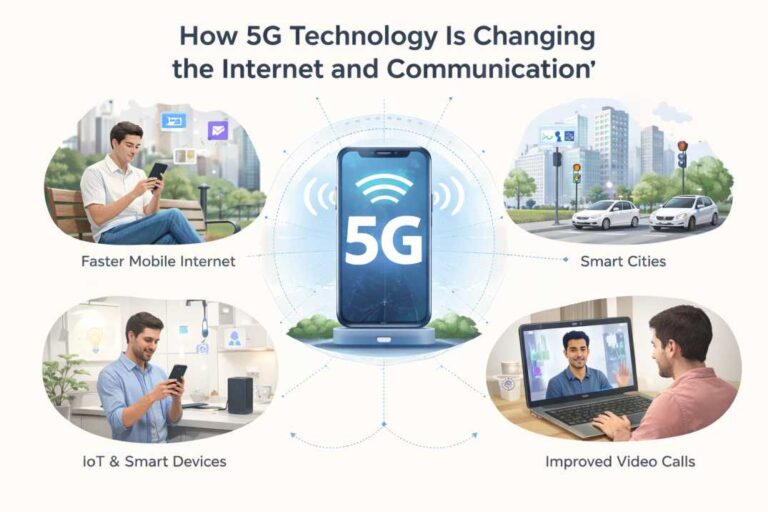
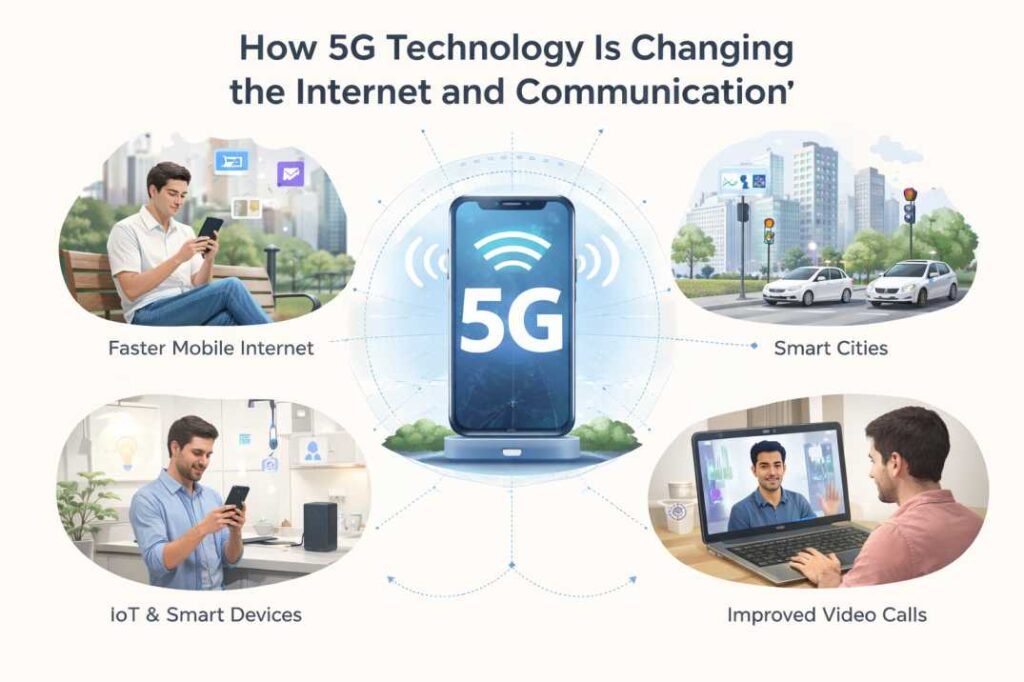

How 5G Technology Is Changing the Internet and Communication
5G technology, the fifth generation of mobile network connectivity, is transforming the way we access the internet. Designed to deliver faster speeds, lower latency, and more reliable connections, 5G is more than just an upgrade from 4G; it is a significant evolution in wireless communication. With the growing reliance on digital services, smart devices, and data-heavy applications, 5G plays a crucial role in supporting modern internet demands.
From streaming high-definition videos to cloud computing and online gaming, today’s digital activities require stronger network capabilities. 5G ensures smoother and more efficient internet performance, enabling both individuals and businesses to experience faster, more stable connections.
Evolution From 4G to 5G
The transition from 4G to 5G marks a major leap in mobile technology. While 4G provided faster internet, improved streaming, and better mobile browsing, it struggled with handling massive numbers of devices and real-time applications efficiently.
5G overcomes these limitations by offering higher data transfer speeds, lower latency, and greater network capacity. It allows more devices to connect simultaneously without slowing down the network. This evolution supports modern innovations like virtual reality, smart city infrastructure, and autonomous technologies, which rely heavily on high-speed, reliable connections.
Why 5G Matters Today
5G is vital in today’s digital world. High-speed connectivity is no longer a luxury; it’s essential for work, education, entertainment, and communication. Faster internet improves productivity, enhances user experience, and supports technologies like smart homes, connected healthcare, and intelligent transportation. With 5G, devices and services operate more efficiently, enabling a smarter, more connected future.
Key Features of 5G Networks
5G networks come with several advanced features that make them stand out from previous generations. These improvements enhance connectivity, speed, and reliability, providing users with better internet experiences.
Ultra-Fast Internet Speeds
5G delivers ultra-fast internet speeds, allowing users to download large files, stream 4K or even 8K videos, and access online services instantly. This is a significant improvement over 4G networks and is particularly useful for streaming platforms, cloud computing, and remote work applications.
Low Latency Communication
5G dramatically reduces latency, making communication nearly instantaneous. This is crucial for applications such as autonomous vehicles, remote surgeries, and online multiplayer gaming.
Massive Device Connectivity
With more devices than ever connecting to the internet, networks must support high volumes of simultaneous connections. 5G can handle millions of connected devices efficiently, making it ideal for smart homes, wearable technology, and IoT (Internet of Things) systems.
You might also like this: Complete Guide to Google AdSense Approval
How 5G Improves Internet Performance
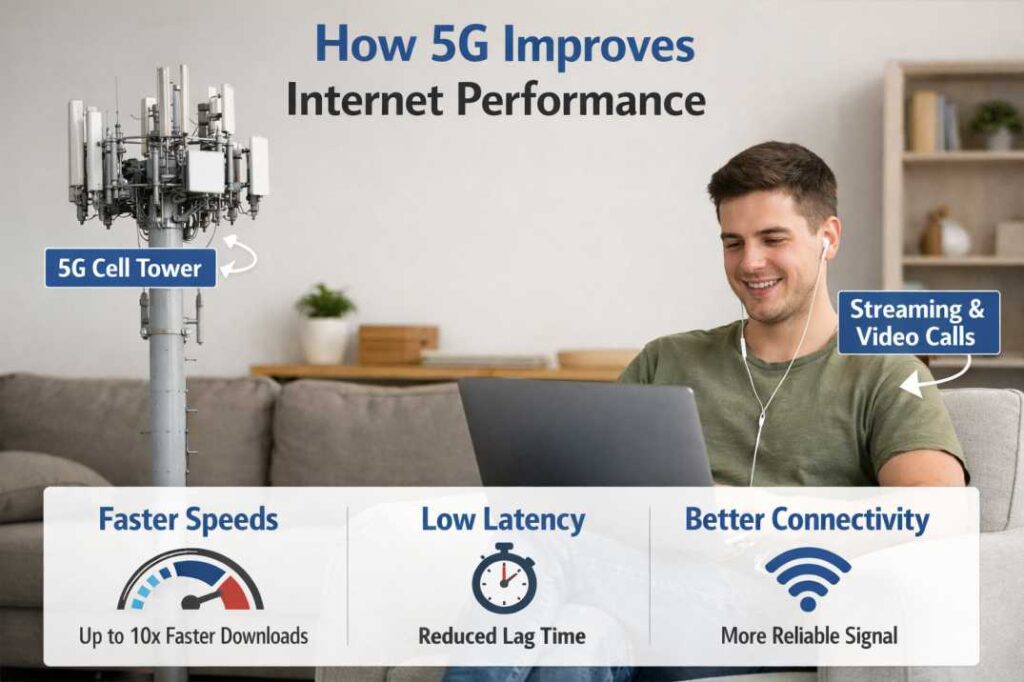
5G significantly enhances internet performance by delivering faster speeds, smoother streaming, and more reliable connections.
Faster Download and Upload Speeds
Users can download large files or upload content to the cloud quickly with 5G. Reduced waiting times improve productivity for individuals and businesses alike, making it easier to handle tasks that require heavy data usage.
Better Streaming and Online Gaming
High-speed 5G networks ensure smooth streaming of high-definition videos without buffering. Gamers benefit from reduced lag and faster response times, making online gameplay more immersive and enjoyable.
Improved Mobile Browsing Experience
5G allows web pages to load quickly, apps to run smoothly, and switching between services without delays. Whether browsing the web, shopping online, or using cloud-based tools, users experience seamless mobile internet performance.
Impact of 5G on Communication
5G is transforming communication by enabling clearer connections and supporting advanced collaboration tools.
High-Quality Video and Voice Calls
Faster networks mean more stable voice and video calls, even on mobile devices. This enables high-definition video conferencing and clear audio calls without interruptions, enhancing both personal and professional communication.
Real-Time Communication Applications
Applications that require instant data transfer, such as live streaming, online collaboration tools, and interactive platforms, benefit from 5G’s low latency. Users experience smoother and faster communication.
Enhanced Remote Collaboration
Remote work has become increasingly common, and 5G makes virtual collaboration more effective. Teams can share files, hold video meetings, and work together seamlessly, regardless of location. This improves productivity and supports the growing trend of remote and hybrid work environments.
5G and the Internet of Things (IoT)
The arrival of 5G technology is revolutionizing the Internet of Things (IoT), creating a more connected and intelligent world. By providing faster speeds, lower latency, and higher capacity, 5G enables seamless communication between devices, supporting smarter homes, cities, and industrial systems.
Smart Homes and Connected Devices
5G allows smart homes to operate more efficiently by connecting multiple devices simultaneously. From smart lights and thermostats to security cameras and voice assistants, devices can communicate instantly with minimal delays. Home automation becomes more responsive, providing users with convenience, energy efficiency, and enhanced security. For instance, a smart thermostat can adjust temperatures in real time based on usage patterns, while connected cameras and sensors can alert homeowners to unusual activity immediately.
Smart Cities and Infrastructure
Smart cities benefit greatly from 5G networks. Traffic management systems, public safety monitoring, and utility services can operate in real time, improving efficiency and quality of life. Connected sensors can monitor traffic flow, optimize street lighting, and manage waste collection more effectively. With 5G, city planners can collect and analyze large amounts of data quickly, allowing for better decision-making and more responsive urban infrastructure.
Industrial IoT Applications
In industries, 5G enhances operational efficiency through Industrial IoT applications. Factories can connect machinery, sensors, and robotics in real time to monitor performance, detect faults, and optimize production processes. For example, predictive maintenance powered by 5G-connected sensors can prevent equipment failures, reducing downtime and improving safety. Additionally, automated systems in logistics and supply chains benefit from faster and more reliable network connections.
You might also like this: What Is BinusCX?
5G in Different Industries
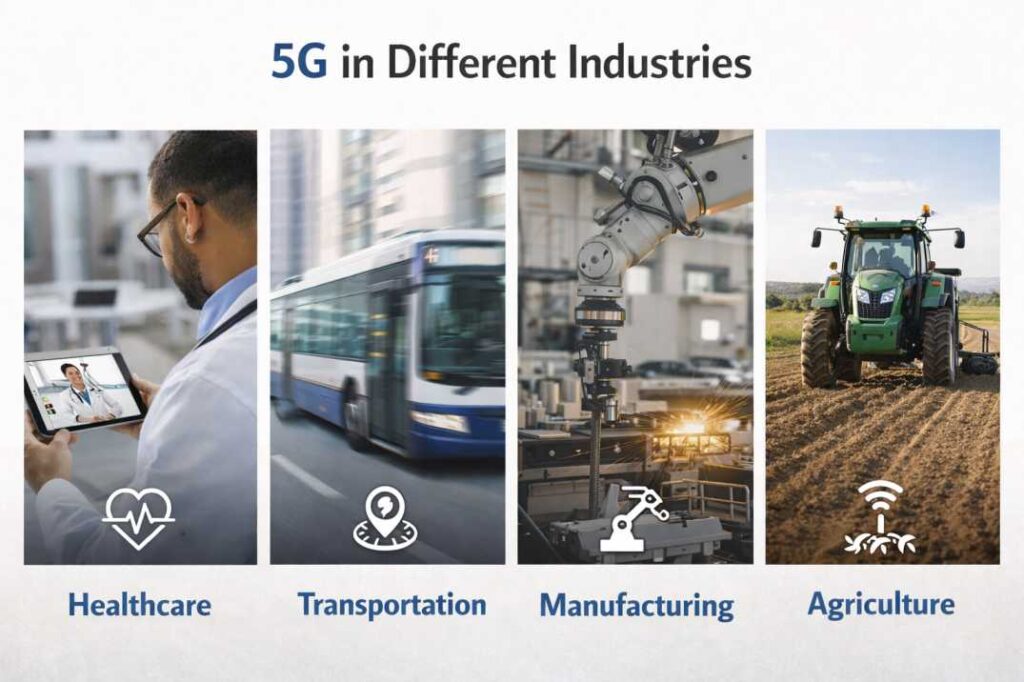
5G technology is not limited to smart homes and cities; it is transforming multiple industries by enabling advanced applications and improved services.
Healthcare and Telemedicine
In healthcare, 5G supports telemedicine, remote surgery, and real-time patient monitoring. Doctors can consult with patients via high-definition video calls, access medical data instantly, and even perform remote procedures using robotic systems. Faster and more reliable connections ensure critical information is transmitted without delay, improving patient care and accessibility.
Transportation and Autonomous Vehicles
5G is a key enabler of autonomous vehicles and smart transportation systems. Vehicles can communicate with each other and with traffic infrastructure in real time, improving road safety and traffic flow. Autonomous cars rely on low-latency 5G connections to make split-second decisions, detect obstacles, and navigate safely. Public transport systems also benefit from real-time tracking, predictive maintenance, and optimized route planning.
Education and Remote Learning
Education has embraced digital learning, and 5G makes remote learning more interactive and effective. Students can attend live classes, access high-quality video lessons, and collaborate on projects without delays. Virtual reality (VR) and augmented reality (AR) learning tools also benefit from 5G connectivity, offering immersive experiences that were previously impossible over slower networks.
Advantages of 5G Technology
The adoption of 5G technology brings significant advantages across personal, industrial, and societal levels.
Faster Connectivity
The most obvious benefit of 5G is its ultra-fast connectivity. Users experience lightning-fast download and upload speeds, enabling smoother streaming, quicker file transfers, and more efficient online collaboration. This speed improvement enhances productivity for both personal and professional use.
Improved Network Reliability
5G provides more stable and reliable connections, even in densely populated areas or during high traffic periods. This ensures consistent service for critical applications such as remote work, telemedicine, and online learning. Reliable connectivity is crucial for industries and services that cannot afford interruptions or delays.
Support for Advanced Technologies
5G supports advanced technologies like autonomous systems, AI, and smart city infrastructure. Its ability to handle large amounts of data quickly and simultaneously allows developers to innovate and implement solutions that were not feasible with previous network generations. From IoT networks to virtual reality applications, 5G opens new possibilities for digital transformation.
Challenges and Concerns of 5G
Despite its benefits, 5G technology faces several challenges and concerns that must be addressed for successful implementation.
Infrastructure Costs
Building 5G networks requires significant investment in infrastructure, including small cell towers, fiber optics, and upgraded network equipment. These costs can be a barrier for service providers, particularly in rural or less densely populated areas, slowing the rollout of 5G coverage.
Security and Privacy Issues
With more devices connected and transmitting data, 5G networks face increased security and privacy risks. Cyberattacks, data breaches, and unauthorized access are major concerns. Strong encryption, secure protocols, and continuous monitoring are necessary to protect users and businesses from potential threats.
Coverage Limitations
Although 5G promises high-speed connectivity, coverage is still limited in many regions. Building sufficient network infrastructure to provide nationwide coverage takes time. Remote and rural areas may face delays in accessing 5G services, creating a digital divide between urban and non-urban populations.
You might also like this: Miuzo Explained
5G vs 4G Technology
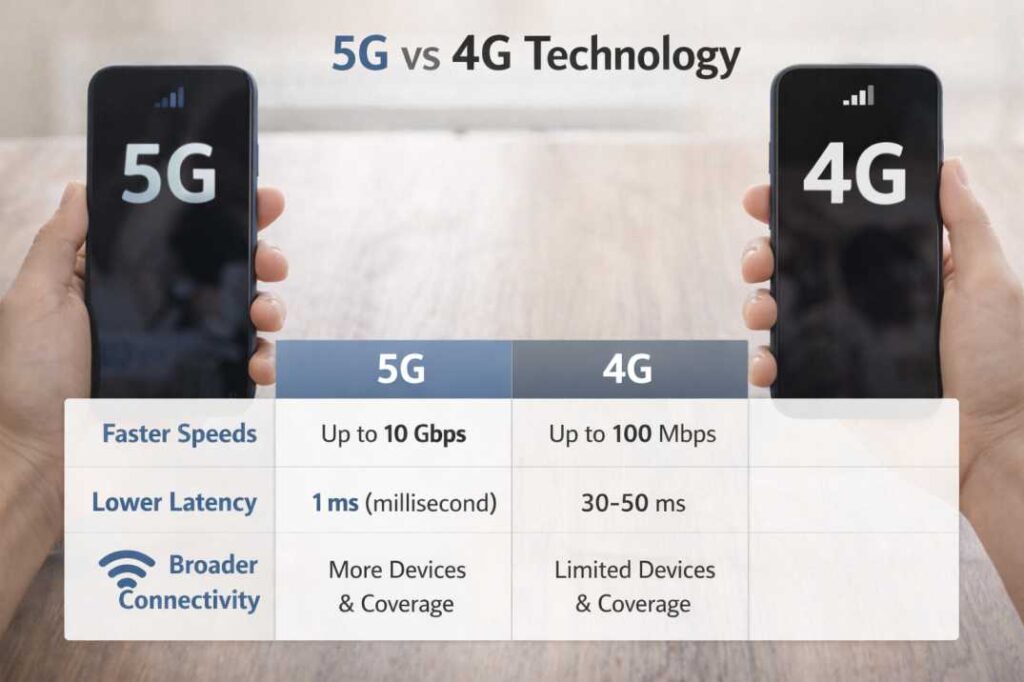
The introduction of 5G technology has sparked widespread discussion about its differences from 4G and the benefits it brings to consumers and businesses. While 4G networks revolutionized mobile internet by enabling high-speed streaming and faster downloads, 5G goes several steps further, offering significant improvements in speed, latency, and network capacity.
Speed Comparison
One of the most noticeable differences between 4G and 5G is internet speed. While 4G networks can offer download speeds of up to 100 Mbps, 5G can reach speeds exceeding 10 Gbps under optimal conditions. This means downloading movies, large files, and software updates takes only a fraction of the time compared to 4G. Faster speeds enhance streaming, gaming, and other data-intensive applications, providing users with a smoother and more seamless experience.
Latency Differences
4G networks generally have a latency of 30-50 milliseconds, which can cause noticeable delays in real-time applications. In contrast, 5G reduces latency to as low as 1 millisecond. This ultra-low latency enables real-time interactions for online gaming, video conferencing, autonomous vehicles, and remote medical procedures. Faster response times improve user experience and allow technologies that were not feasible with 4G.
Network Capacity
Network capacity refers to the number of devices that can connect simultaneously without slowing down performance. 4G networks often struggle in densely populated areas where many devices are connected at the same time. 5G, however, is designed to handle thousands of devices per square kilometer, making it ideal for smart cities, IoT networks, and public events. Higher network capacity ensures stable connections even when multiple devices are online simultaneously.
The Future of 5G Technology
5G is not just about faster internet; it is a foundation for future technological advancements that will transform industries and daily life. Its low latency, high speed, and massive device support make it suitable for a range of applications beyond traditional mobile use.
Integration With Artificial Intelligence
5G and artificial intelligence (AI) complement each other perfectly. AI systems require large amounts of data and fast processing speeds, both of which 5G provides. For example, AI-powered traffic management, predictive analytics, and automated industrial systems rely on rapid data transmission to function efficiently. As 5G networks expand, AI technologies will become more responsive, accurate, and capable of handling complex real-time decisions.
Growth of Smart Cities
5G is critical for building smart cities, where connected infrastructure improves public services, energy efficiency, and quality of life. Traffic signals, public transportation, utility management, and security systems can all operate in real time using 5G networks. Smart cities will benefit from improved monitoring, reduced congestion, and better resource allocation, making urban environments more efficient and sustainable.
What to Expect Beyond 5G
Looking beyond 5G, researchers are already exploring technologies like 6G, which promise even higher speeds, lower latency, and more intelligent networks. While 5G is set to enable IoT, autonomous vehicles, and enhanced connectivity, 6G may introduce ultra-reliable global coverage, holographic communication, and advanced AI-driven networks. The future of wireless communication will continue to evolve rapidly, creating new opportunities for innovation.
Frequently Asked Questions (FAQs)
What makes 5G faster than 4G?
5G achieves higher speeds through advanced technologies like millimeter waves, massive MIMO antennas, and improved spectrum utilization. These advancements allow faster data transfer and greater network efficiency compared to 4G.
Is 5G available everywhere?
Currently, 5G is available in many urban and suburban areas, but coverage is limited in rural and remote regions. Network providers are gradually expanding infrastructure to ensure wider access over the next few years.
Do you need a new phone for 5G?
Yes, to take full advantage of 5G speeds and low latency, users need a 5G-compatible device. Older 4G phones will continue to work on existing networks, but cannot access 5G features.
How does 5G affect internet speed?
5G significantly improves internet speed, allowing faster downloads, smoother streaming, and better performance for real-time applications. It also reduces latency, providing near-instant responses for connected devices and applications.
You might also like this: Best AI Tools for Content Creators
Conclusion

5G technology represents a major leap forward from 4G, offering faster speeds, lower latency, and higher network capacity. It is not only transforming mobile connectivity but also enabling the future of smart cities, IoT, and AI-driven applications. While coverage and infrastructure are still expanding, the benefits of 5G are clear: enhanced communication, improved user experiences, and the foundation for advanced technologies. As 5G networks continue to grow, they will redefine how we live, work, and interact with technology, creating a more connected and efficient world.