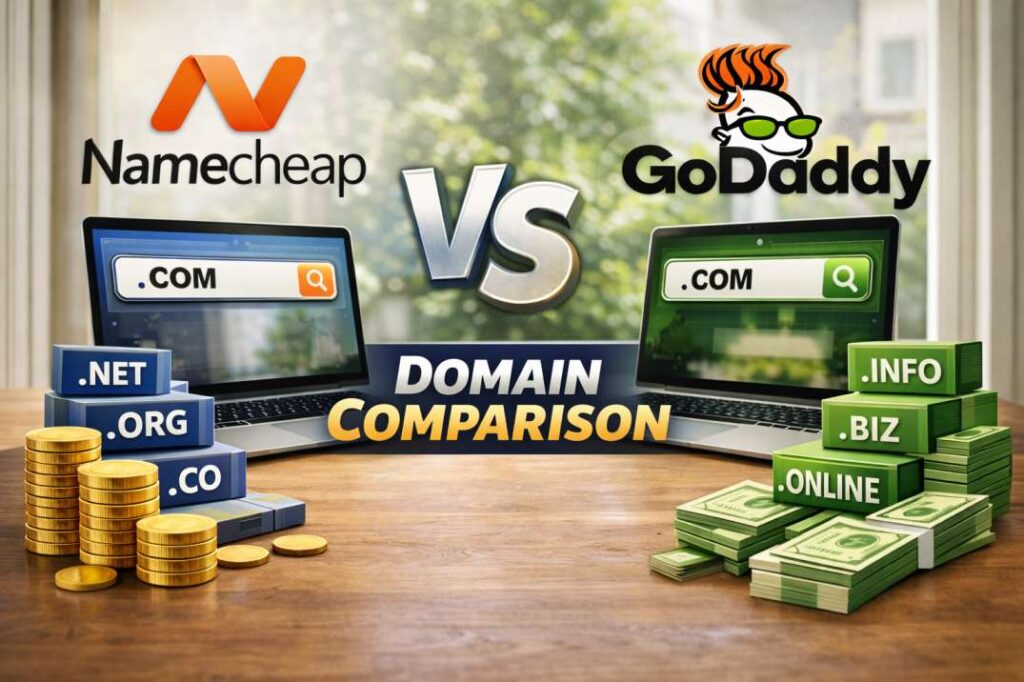

Namecheap vs GoDaddy: Domain Comparison
Choosing the right domain registrar is one of the first and most important decisions when launching a website. In this comparison, we look closely at Namecheap and GoDaddy, two of the biggest names in the domain industry. Both companies offer domain registration, hosting, and related services, but they differ in pricing structure, features, and overall user experience.
What is Namecheap?
Namecheap is a domain registrar known for affordable pricing and transparent policies. Founded in 2000, the company has built a strong reputation among bloggers, startups, and small business owners who want cost-effective domain management.
One of Namecheap’s biggest selling points is its commitment to value. It includes free WHOIS privacy protection with most domain registrations, which helps protect your personal information from being publicly visible. In addition to domains, Namecheap offers web hosting, email hosting, SSL certificates, and a website builder.
The platform is often praised for its clean dashboard, straightforward pricing, and minimal upselling. For users who want simplicity and long-term affordability, Namecheap is frequently considered a top choice.
What is GoDaddy?
GoDaddy is one of the largest and most recognized domain registrars in the world. Established in 1997, it manages millions of domain names globally and offers a wide range of services, including hosting, website building tools, professional email, and online marketing solutions.
GoDaddy is known for its aggressive promotional pricing and extensive marketing campaigns. Many beginners are drawn to its low first-year domain prices and bundled packages. The company also offers phone support, which can be reassuring for users who prefer speaking directly to a representative.
Because of its size and broad service ecosystem, GoDaddy often appeals to businesses that want an all-in-one platform for domains, hosting, and website management.
Who Are These Registrars Best For?
- Namecheap is ideal for budget-conscious bloggers, freelancers, and small business owners who value free privacy protection and lower renewal costs.
- GoDaddy is better suited for beginners who want guided setup processes, phone support, and access to bundled services.
Your choice ultimately depends on whether you prioritize long-term savings or convenience and brand familiarity.
Domain Pricing Comparison
Pricing is often the deciding factor when choosing between Namecheap and GoDaddy. While both offer competitive deals, their pricing strategies differ significantly.
.com Domain Pricing
The .com extension remains the most popular domain choice worldwide. Both registrars frequently advertise discounted first-year prices for .com domains.
GoDaddy often promotes very low introductory prices for new customers. However, these promotional rates usually apply only to the first year. Namecheap also provides competitive first-year pricing, though sometimes slightly higher than GoDaddy’s introductory offers.
If you’re focused only on initial cost, GoDaddy may seem more attractive. But the full picture becomes clearer when you examine renewal rates.
Renewal Costs
Renewal pricing is where many users feel the biggest difference. After the first year, GoDaddy’s renewal rates are typically higher than its promotional price. In some cases, the jump can be significant.
Namecheap, on the other hand, generally offers more consistent and predictable renewal pricing. While renewals are higher than first-year discounts, the increase is usually more moderate compared to GoDaddy.
For long-term website owners who plan to keep their domain for several years, renewal costs can have a major impact on overall expenses.
Transfer Pricing
Domain transfers are important if you decide to switch registrars later. Both companies allow domain transfers, usually including a one-year extension upon completion.
Namecheap often provides competitive transfer rates and a straightforward process. GoDaddy also supports transfers, but pricing can vary depending on the extension.
Before transferring, always compare total transfer costs and confirm that your domain meets eligibility requirements, such as being older than 60 days.
Hidden Fees and Upsells
One of the biggest complaints users have about domain registrars involves hidden fees and upsells.
GoDaddy is known for offering additional services during checkout, such as domain privacy, email hosting, and website security add-ons. While these services can be useful, they increase the total cost.
Namecheap’s checkout process is generally cleaner, and it includes free WHOIS privacy for many domains. This makes pricing more transparent and easier to understand upfront.
If you prefer fewer surprises at checkout, Namecheap may offer a smoother buying experience.
You might also like this: What is serlig?
Domain Extensions and Availability
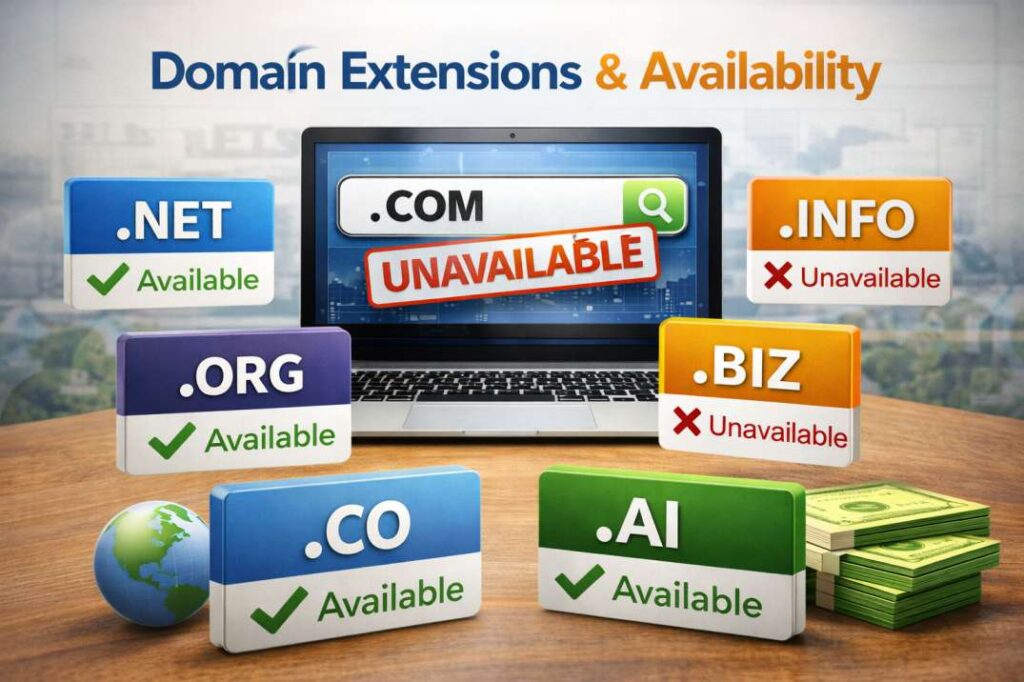
Beyond pricing, domain extension options play a critical role in choosing a registrar.
Popular TLD Options (.com, .net, .org)
Both Namecheap and GoDaddy support major top-level domains (TLDs) such as:
- .com
- .net
- .org
Availability typically depends on whether the domain name itself is already registered. In terms of selection, both platforms provide access to a wide range of standard extensions.
For most users building blogs, portfolios, or business websites, either registrar will meet basic TLD needs.
Country-Code Domains (ccTLDs)
If you’re targeting a specific country, country-code domains (ccTLDs) like .uk, .ca, or .pk can be useful.
Both registrars offer numerous country-specific extensions. However, availability and pricing may vary depending on local registry rules. Some ccTLDs require additional documentation or residency verification.
Before purchasing, check eligibility requirements and renewal pricing for your chosen country extension.
Premium Domain Options
Premium domains are names considered highly valuable due to keywords, branding potential, or short length. These domains are often priced significantly higher than standard registrations.
Both Namecheap and GoDaddy list premium domains in their search results. GoDaddy also operates a domain auction platform, where users can bid on expired or investor-owned domains.
If you’re looking for a brandable or keyword-rich domain, both platforms provide access to premium inventory.
User Interface and Ease of Use
A registrar’s interface can significantly affect your overall experience, especially if you manage multiple domains.
Dashboard Experience
Namecheap’s dashboard is widely appreciated for its clean layout and straightforward navigation. Users can quickly access domain management tools, DNS settings, and renewal options without excessive clutter.
GoDaddy’s dashboard is more feature-rich but can feel slightly overwhelming for new users. It integrates various services like hosting, email, and marketing tools into one central panel.
If you prefer simplicity, Namecheap may feel more intuitive. If you want access to many integrated tools in one place, GoDaddy’s interface might be more appealing.
Domain Search Process
Both registrars provide fast domain search tools with instant availability results. GoDaddy often suggests alternative names and related extensions during search, which can be helpful for brainstorming.
Namecheap also offers suggestions but maintains a cleaner results page with fewer promotional distractions.
In terms of speed and reliability, both perform well.
Managing DNS Settings
DNS management is essential for connecting your domain to hosting, email services, or third-party platforms.
Namecheap provides easy access to DNS records with a straightforward editing interface. GoDaddy also allows DNS management, but may require navigating through additional menus.
Advanced users will find both platforms capable, but beginners may appreciate Namecheap’s simpler layout for basic DNS tasks.
Customer Support Comparison
Reliable customer support is essential when managing your domain, especially if you encounter technical issues or billing concerns. Both Namecheap and GoDaddy provide multiple support channels, but their approach and accessibility differ.
Live Chat and Ticket Support
Live chat has become one of the most preferred support methods for domain owners. Namecheap offers 24/7 live chat support, allowing users to connect with an agent in real time. The process is straightforward, and wait times are typically reasonable. For more complex issues, users can submit support tickets through their account dashboard.
GoDaddy also provides live chat support, although availability may vary depending on region and service type. In addition to chat, users can open support tickets for billing, technical, or account-related concerns.
In terms of responsiveness, both companies perform well. However, many users appreciate Namecheap’s direct and less sales-driven support style, especially when resolving domain or DNS-related problems.
Phone Support Availability
Phone support can be a major deciding factor for beginners or businesses that prefer speaking directly with a representative.
GoDaddy has a strong advantage in this area. It offers phone support in multiple countries, which makes it appealing for users who want immediate verbal assistance. This can be particularly helpful when handling urgent issues like domain expiration or website downtime.
Namecheap does not typically offer traditional phone support for most customers. Instead, it focuses on live chat and ticket-based systems. While effective, this may not suit users who prefer direct phone communication.
If phone support is a priority, GoDaddy may be the better option.
Knowledge Base & Tutorials
A well-developed knowledge base can save time and reduce the need for direct support.
Namecheap provides a detailed help center with step-by-step tutorials, FAQs, and troubleshooting guides. Topics range from domain transfers and DNS configuration to hosting setup and email configuration.
GoDaddy also offers an extensive help center filled with video tutorials, articles, and walkthroughs. Due to its broad range of services, the documentation covers everything from domain management to website building and digital marketing.
Both registrars maintain comprehensive educational resources, making it easier for users to solve common issues independently.
You might also like this: Laaster Review 2026
Security Features and Privacy Protection
Domain security is critical for protecting your online identity and preventing unauthorized access. Both registrars offer essential security tools, but there are key differences in pricing and implementation.
WHOIS Privacy
WHOIS privacy protects your personal contact information from being publicly displayed in the domain database.
Namecheap includes free WHOIS privacy with most eligible domain registrations. This means your name, email address, and phone number remain hidden without additional cost.
GoDaddy, on the other hand, often charges extra for domain privacy protection, depending on the plan or promotion. While the feature works effectively, it can increase the overall cost of domain ownership.
For users who value privacy and want to avoid extra fees, Namecheap offers a clear advantage.
Two-Factor Authentication
Two-factor authentication (2FA) adds a layer of account security by requiring a second verification method, such as a mobile code or authentication app.
Both Namecheap and GoDaddy support two-factor authentication to protect user accounts. Enabling 2FA significantly reduces the risk of unauthorized access, especially for users managing multiple domains or high-value properties.
Security-conscious website owners should activate this feature regardless of the registrar they choose.
Domain Locking & Security Tools
Domain locking prevents unauthorized domain transfers. When a domain is locked, it cannot be moved to another registrar without explicit approval.
Both companies provide domain locking as a standard feature. Users can easily enable or disable it from their dashboard.
In addition, both registrars offer advanced security add-ons such as DNSSEC (Domain Name System Security Extensions) for extra protection against DNS spoofing attacks.
Overall, both platforms provide strong security foundations, but Namecheap’s free privacy inclusion gives it an edge in cost efficiency.
Hosting and Additional Services
Beyond domain registration, many users look for bundled services such as hosting, email, and website builders. Both Namecheap and GoDaddy aim to provide all-in-one solutions.
Web Hosting Plans
Its hosting plans are generally affordable and suitable for small to medium-sized websites.
GoDaddy also provides a wide range of hosting services, including managed WordPress hosting and business hosting plans. Due to its large customer base, GoDaddy frequently bundles hosting with domain promotions.
While both companies deliver reliable hosting, pricing and included features vary. Users should compare storage limits, bandwidth, and renewal costs before committing.
Email Hosting
Professional email addresses enhance credibility for businesses.
Namecheap offers private email hosting plans that integrate with your domain. These plans are typically budget-friendly and easy to configure.
GoDaddy also provides professional email services, often powered by Microsoft 365. This can be appealing for businesses already using Microsoft tools.
If you need business-grade email with productivity tools, GoDaddy’s integration may be beneficial. For basic branded email at a lower cost, Namecheap is often sufficient.
Website Builder Tools
Both registrars offer website builders for users without coding experience.
Namecheap provides a drag-and-drop website builder designed for simplicity and small business use. It’s suitable for portfolios, landing pages, and basic websites.
GoDaddy’s website builder includes marketing tools, appointment scheduling, and e-commerce functionality. It’s designed as a complete small-business solution.
For simple projects, both platforms work well. For more advanced marketing features, GoDaddy’s builder may offer additional flexibility.
SSL Certificates
SSL certificates encrypt data between your website and visitors, improving security and SEO.
Namecheap offers competitively priced SSL certificates with various validation levels. GoDaddy also provides SSL solutions, but pricing may be higher depending on the plan.
Since SSL is essential for website security and search engine trust, comparing certificate types and renewal pricing is important.
Performance and Reliability
Performance impacts website speed, uptime, and overall user experience.
DNS Speed
DNS speed determines how quickly your domain connects visitors to your website.
Both Namecheap and GoDaddy maintain global DNS infrastructure designed for fast resolution times. In most cases, users will not notice significant differences in DNS performance between the two providers.
For standard websites, both offer reliable DNS management.
Uptime Reputation
While domain registrars primarily manage domains rather than hosting uptime, their DNS systems must remain stable.
Both companies have established reputations for reliability and stable infrastructure. Downtime incidents are rare and typically resolved quickly.
Consistent uptime ensures your domain remains accessible without interruption.
Infrastructure Overview
GoDaddy operates a large global infrastructure supporting millions of domains. Its scale allows it to handle high traffic volumes efficiently.
Namecheap also maintains a strong infrastructure, focusing on performance, security, and scalability for growing websites.
Ultimately, both registrars deliver reliable domain management. Differences are more noticeable in pricing structure and service style than in technical reliability.
You might also like this: Kerkt Explained
Pros and Cons of Namecheap
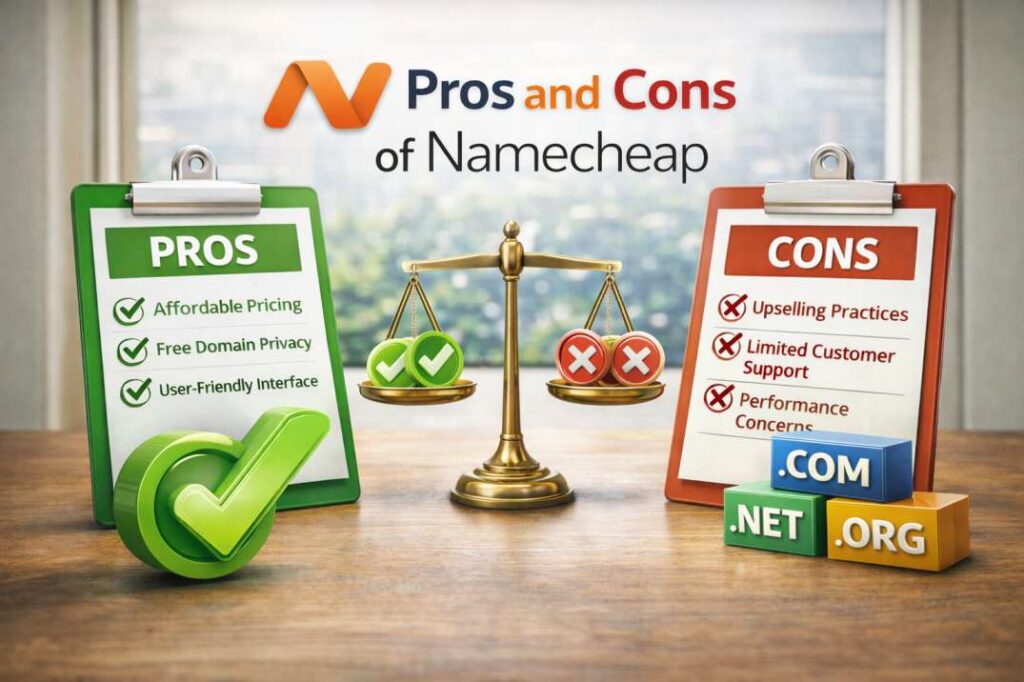
When evaluating Namecheap, it’s important to weigh both its strengths and limitations. While it’s widely known for affordability and transparency, it may not be perfect for every user.
Key Advantages
One of Namecheap’s biggest advantages is its competitive pricing structure. The company offers affordable domain registration rates and, more importantly, reasonable renewal costs. Unlike many registrars that significantly increase renewal fees after the first year, Namecheap tends to keep pricing more predictable.
Another major benefit is free WHOIS privacy protection for most eligible domains. This feature helps protect personal contact details from being publicly visible, reducing spam and enhancing security.
Namecheap is also praised for its clean and user-friendly dashboard. Domain management, DNS configuration, and renewals are straightforward, making it suitable for beginners and experienced users alike.
Additionally, the checkout process is generally transparent, with fewer aggressive upsells compared to competitors. This makes the buying experience smoother and less confusing.
Main Drawbacks
Despite its advantages, Namecheap does have some limitations. One notable drawback is the lack of traditional phone support. While live chat and ticket support are available 24/7, some users prefer speaking directly to a representative.
Another limitation is that Namecheap’s ecosystem of additional services, such as marketing tools or advanced business integrations, may not be as extensive as those of larger competitors.
For users seeking a comprehensive all-in-one business platform, Namecheap may feel more minimalistic.
Pros and Cons of GoDaddy
As one of the largest domain registrars globally, GoDaddy offers a wide range of services. However, its scale comes with both strengths and weaknesses.
Key Advantages
GoDaddy’s strongest advantage is its brand reputation and global presence. With millions of domains under management, it has built a trusted name in the industry.
One of its standout features is phone support availability in multiple regions. For beginners or business owners who want immediate assistance, this can be extremely valuable.
GoDaddy also offers a broad ecosystem that includes hosting, website building tools, email services, marketing solutions, and domain auctions. This makes it appealing for businesses that prefer managing everything under one platform.
Additionally, the company frequently runs promotional discounts on first-year domain registrations, which can make the initial purchase very affordable.
Main Drawbacks
The most common criticism of GoDaddy involves higher renewal rates. After the first-year promotional period, domain renewal costs can increase significantly.
Another concern is upselling during checkout. Additional services such as domain privacy, email, and security tools are often presented as add-ons, which can increase the final price.
While GoDaddy’s dashboard is feature-rich, some users find it slightly cluttered compared to simpler interfaces.
Namecheap vs GoDaddy: Side-by-Side Comparison Table
To make your decision easier, here’s a simplified comparison of the two registrars.
Pricing Summary
| Feature | Namecheap | GoDaddy |
| First-Year .com Pricing | Competitive | Often, a lower promotional rate |
| Renewal Costs | Moderate & predictable | Typically higher |
| WHOIS Privacy | Free (most domains) | Usually paid add-on |
| Transfer Pricing | Competitive | Varies by extension |
Overall, Namecheap often provides better long-term value due to lower renewal costs and included privacy protection.
Feature Comparison
| Feature | Namecheap | GoDaddy |
| Live Chat Support | Yes (24/7) | Yes |
| Phone Support | No | Yes |
| Free WHOIS Privacy | Yes | Often extra cost |
| Hosting Services | Yes | Yes |
| Website Builder | Yes | Yes (with marketing tools) |
| Domain Auctions | Limited | Yes |
Both registrars cover essential domain management features, but GoDaddy offers a broader service ecosystem, while Namecheap focuses on affordability and simplicity.
Best Value for Money
If you are planning to keep your domain for several years, Namecheap typically offers better long-term value due to:
- Lower renewal pricing
- Free privacy protection
- Transparent checkout process
However, if you prefer bundled services, phone support, and a recognized global brand, GoDaddy may justify its higher cost.
You might also like this: Trucofax Review 2026
Frequently Asked Questions (FAQs)
Is Namecheap cheaper than GoDaddy?
In many cases, Namecheap is cheaper in the long run due to lower renewal costs and free WHOIS privacy. GoDaddy may offer lower first-year promotional pricing, but renewals are often higher.
Which registrar is better for beginners?
Both platforms are beginner-friendly. However, GoDaddy may feel more supportive of beginners who prefer phone assistance and guided setup processes. Namecheap offers a simpler and cleaner dashboard for easy domain management.
Does GoDaddy charge for WHOIS privacy?
In most cases, yes. GoDaddy typically treats domain privacy as an add-on service, while Namecheap includes it free with eligible domain registrations.
Is it easy to transfer a domain from GoDaddy to Namecheap?
Yes, transferring a domain is straightforward. You need to unlock your domain, obtain the authorization (EPP) code, and initiate the transfer from Namecheap.
Which is better for long-term domain ownership?
For long-term ownership, Namecheap is often more cost-effective due to lower renewal fees and included privacy protection. However, businesses that value phone support and integrated services may prefer GoDaddy.
Conclusion
Choosing between Namecheap and GoDaddy ultimately depends on your priorities as a website owner.
If your main focus is affordability, free WHOIS privacy, and transparent pricing, Namecheap stands out as a strong option. Its user-friendly interface and predictable renewal costs make it particularly attractive for bloggers, freelancers, and small business owners.
On the other hand, if you value phone support, brand recognition, and access to a comprehensive suite of business tools, GoDaddy may better suit your needs. Its broad ecosystem allows users to manage domains, hosting, marketing, and email services all in one place.
Both registrars are legitimate, reliable, and capable of managing your domain effectively. The best choice comes down to whether you prioritize long-term savings or convenience and integrated services. By carefully evaluating pricing, features, and support options, you can confidently select the registrar that aligns with your goals.