


How to Use AI for Keyword Research and Content Planning
AI-powered keyword research is the process of using artificial intelligence tools to find relevant search terms that people use online. Instead of manually searching for keywords, AI analyzes large datasets, search trends, and user behavior to suggest the best keywords for content. These tools use machine learning to understand patterns and deliver insights that help bloggers and marketers target the right audience more effectively in competitive search environments today.
Why AI is important for modern SEO strategies
AI has become essential for modern SEO because search engines are smarter than ever. Traditional keyword research methods are slow and often miss valuable opportunities. AI helps automate complex tasks, analyze competition, and predict trends quickly. It allows businesses to create data-driven strategies that improve rankings and visibility. With AI, marketers can stay ahead of competitors by adapting to changing search behaviors and delivering more relevant content to users.
Benefits of Using AI for Keyword Research
Faster data analysis and insights
One of the biggest advantages of AI is its ability to process large amounts of data in seconds. AI tools analyze search volume, competition, and trends much faster than manual methods. This helps businesses identify keyword opportunities quickly and make faster decisions. Instead of spending hours on research, marketers can get instant insights and focus more on content creation and optimization, improving overall productivity and efficiency.
Improved accuracy and keyword opportunities
AI tools provide more accurate keyword suggestions by analyzing real user data and search patterns. They identify hidden opportunities that traditional methods may overlook. This includes long-tail keywords and niche topics that have less competition but high potential. Improved accuracy ensures that businesses target keywords that bring relevant traffic, increasing chances of higher rankings and better conversion rates in search engine results.
You might also like this: Konversky: The Future of AI-Powered Customer Conversations
Understanding Search Intent with AI
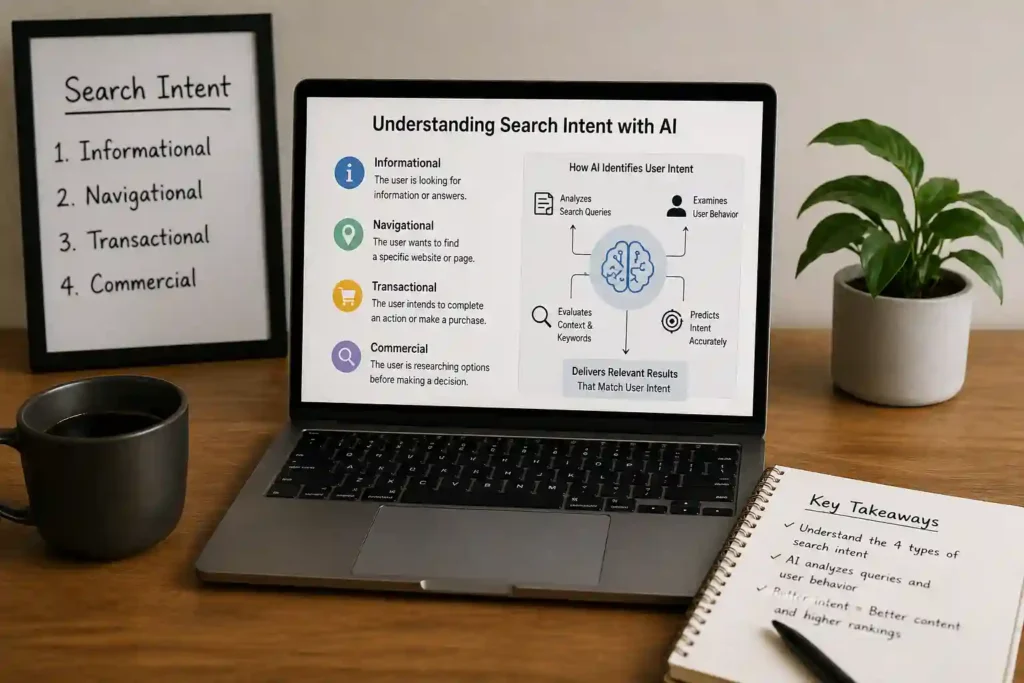
Types of search intent in SEO
There are four main types: informational, navigational, transactional, and commercial. Informational intent focuses on learning something, while navigational intent is about finding a specific website. Transactional intent indicates a desire to make a purchase, and commercial intent involves comparing options before buying. Understanding these types helps businesses create content that matches user expectations.
How AI identifies user intent
AI tools analyze user behavior, search patterns, and query context to determine search intent. They study factors like click-through rates, time spent on pages, and keyword phrasing to understand what users want. This helps marketers create content that aligns with user needs. By targeting the right intent, businesses can improve engagement, reduce bounce rates, and increase the chances of ranking higher on search engines.
Finding High-Value Keywords Using AI
Short-tail vs long-tail keywords
Short-tail keywords are broad search terms with high search volume but strong competition. Long-tail keywords are more specific phrases with lower competition and higher conversion potential. AI helps identify both types and suggests the best mix for a balanced strategy. While short-tail keywords drive traffic, long-tail keywords attract targeted users who are more likely to take action, making them valuable for SEO success.
Identifying low-competition keywords
AI tools make it easier to find low-competition keywords that can rank faster on search engines. They analyze keyword difficulty, search trends, and competitor data to highlight opportunities with less competition. Targeting these keywords allows new websites and blogs to gain visibility quickly. By focusing on less competitive terms, businesses can build authority and gradually compete for more competitive keywords over time.
Competitor Keyword Analysis with AI
Analyzing competitor strategies
AI-powered competitor analysis helps businesses understand what is working for others in their niche. Instead of manually reviewing multiple websites, AI tools quickly scan competitor content, keywords, and rankings. They identify which keywords drive the most traffic and how competitors structure their content. This allows marketers to learn from successful strategies and improve their own SEO approach. By studying competitors, businesses can avoid guesswork and make smarter decisions based on real data and performance insights.
Finding keyword gaps using AI tools
Keyword gaps are opportunities that competitors are not targeting effectively. AI tools make it easy to discover these gaps by comparing multiple websites and identifying missing or underused keywords. This helps businesses create content that fills those gaps and attracts untapped traffic. Instead of competing for highly saturated keywords, marketers can focus on less competitive terms with strong potential. Finding keyword gaps also allows businesses to expand their content strategy and cover topics that others have overlooked.
You might also like this: Schedow: The Ultimate Platform for Smart Scheduling and Productivity
AI Tools for Keyword Research
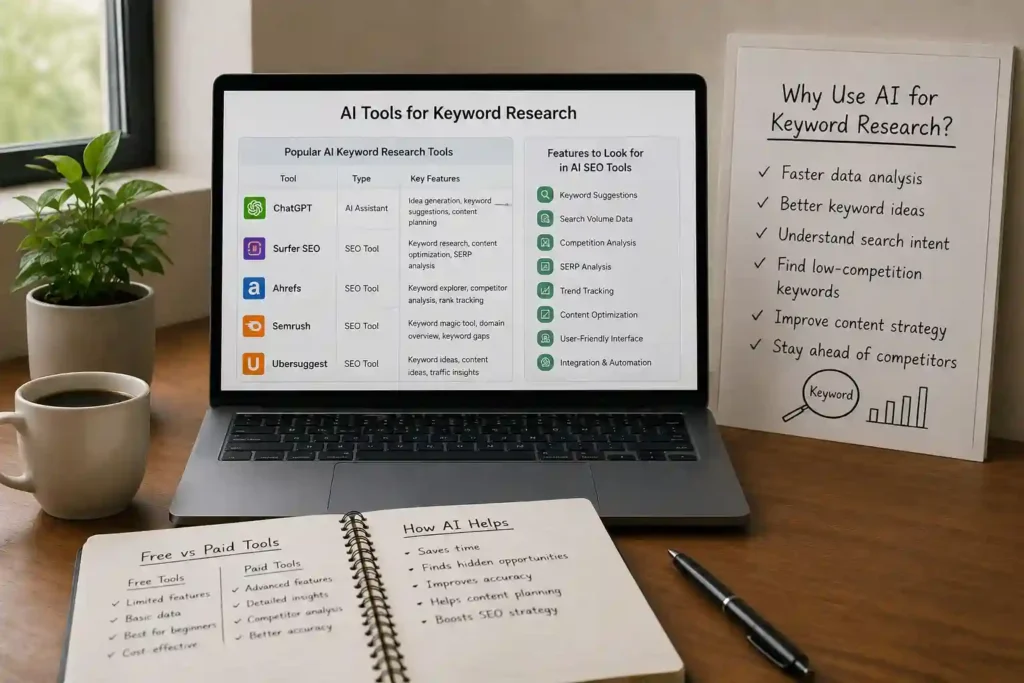
Free vs paid keyword research tools
There are both free and paid AI tools available for keyword research, each offering different levels of functionality. Free tools are useful for beginners and provide basic insights such as keyword suggestions and search volume. Paid tools, on the other hand, offer advanced features like competitor analysis, keyword difficulty scores, and detailed trend data. Businesses with larger goals often invest in paid tools for more accurate and in-depth analysis. Choosing between free and paid tools depends on budget, needs, and the level of competition in your niche.
Features to look for in AI SEO tools
When selecting an AI SEO tool, it is important to focus on features that improve efficiency and accuracy. Look for tools that provide keyword suggestions, search volume data, competition analysis, and trend tracking. Advanced tools also offer content optimization recommendations and SERP analysis. User-friendly interfaces and automation features are equally important, as they save time and simplify workflows. A good AI tool should help you make data-driven decisions and support your overall content strategy effectively.
Creating Content Clusters with AI
What are topic clusters?
Topic clusters are a content strategy where multiple related articles are grouped around a central topic. This approach helps improve website structure and makes it easier for search engines to understand your content. A main pillar page covers a broad topic, while supporting articles focus on specific subtopics. This interconnected structure boosts SEO performance and increases authority on a subject. Topic clusters also improve user experience by guiding readers through related content in a logical way.
Using AI to build content structures
AI simplifies the process of creating content clusters by analyzing keywords and suggesting related topics. It can identify subtopics, organize them into clusters, and recommend how to link them together. This helps marketers build a strong content structure without spending hours on planning. AI also ensures that all important aspects of a topic are covered, improving content depth and relevance. By using AI for structure planning, businesses can create more organized and SEO-friendly content that ranks better.
AI for Content Planning and Strategy
Generating blog ideas using AI
AI tools are highly effective for generating blog ideas based on current trends and user interests. They analyze search data, popular topics, and competitor content to suggest relevant ideas. This helps marketers avoid content gaps and maintain a consistent publishing schedule. AI-generated ideas are often aligned with what users are actively searching for, increasing the chances of higher engagement and traffic. This makes content planning faster and more strategic.
Building an SEO content calendar
An SEO content calendar helps businesses plan and organize their content over time. AI tools assist in building calendars by suggesting publishing schedules, keyword priorities, and content topics. They ensure that content is distributed evenly and aligned with business goals. Automation features also help track deadlines and update plans based on performance data. A well-structured calendar improves consistency, enhances SEO results, and ensures long-term growth in organic traffic for blogs and websites.
You might also like this: Rosboxar: Trusted Digital Solutions Platform for Businesses in 2026
Optimizing Content with AI Tools
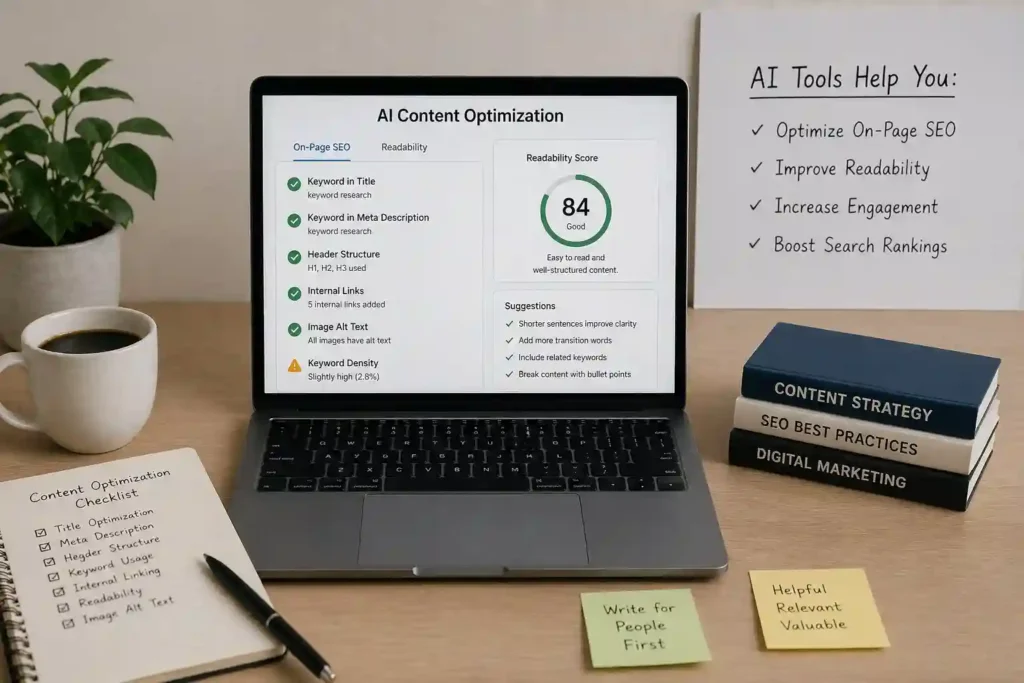
On-page SEO optimization using AI
AI tools have transformed on-page SEO by making optimization faster and more precise. These tools analyze keywords, headings, meta tags, and internal links to ensure content follows best SEO practices. They provide real-time suggestions to improve keyword placement, optimize titles, and enhance structure. AI can also evaluate competitor pages and recommend improvements that help content rank higher. By automating technical aspects, businesses can focus more on creating valuable content while ensuring it is fully optimized for search engines and user experience across digital platforms today.
Improving readability and engagement
AI tools help improve readability by analyzing sentence structure, tone, and clarity. They suggest simpler wording, better formatting, and proper grammar to make content easier to understand. This increases user engagement and keeps readers on the page longer. AI also recommends adding headings, bullet points, and relevant keywords to improve flow. Engaging content not only attracts more visitors but also reduces bounce rates. By using AI, businesses can create content that is both SEO-friendly and enjoyable for readers, improving overall performance and user satisfaction consistently.
Automating Content Workflow
AI tools for content writing
AI writing tools allow businesses to generate high-quality content quickly and efficiently. These tools can create blog posts, product descriptions, and marketing copy based on user input. They help save time by reducing the need for manual writing and editing. AI also ensures consistency in tone and style across all content. This makes it easier for businesses to maintain a strong brand voice while producing large amounts of content regularly without sacrificing quality or accuracy in their communication strategies.
Streamlining publishing and updates
Automation tools simplify the process of publishing and updating content across websites and platforms. AI can schedule posts, optimize publishing times, and update old content based on new trends. Businesses can also track performance metrics and make improvements automatically. Streamlining workflows reduces manual effort and helps maintain consistency in content delivery. As a result, companies can focus more on strategy and growth instead of repetitive publishing tasks in daily operations.
Common Mistakes to Avoid
Over-reliance on AI tools
While AI tools are powerful, relying on them completely can lead to generic and less impactful content. AI may not fully understand context, audience emotions, or brand voice. Businesses should use AI as a support tool rather than a complete replacement for human input. Combining AI efficiency with human creativity ensures better results. Over-reliance can also lead to duplicated or low-quality content if not monitored properly, which can negatively affect SEO performance and user trust over time.
Ignoring human creativity and quality
Human creativity plays a crucial role in creating unique and engaging content. AI can assist with structure and ideas, but it cannot replace originality and emotional connection. Ignoring quality and creativity can result in content that feels robotic and uninteresting. Businesses should always review and refine AI-generated content to ensure it meets high standards. Adding personal insights, storytelling, and unique perspectives helps content stand out and perform better in search engine rankings and user engagement.
You might also like this: Repmold: A Smart Platform for Digital Solutions and Business Growth
Frequently Asked Questions (FAQs)

What is AI keyword research?
AI keyword research uses artificial intelligence tools to find relevant keywords by analyzing search data, trends, and user behavior quickly and accurately.
Which AI tools are best for SEO?
Popular AI SEO tools include keyword research platforms, content optimization tools, and analytics software that improve rankings and content performance.
Can AI replace traditional SEO methods?
AI cannot fully replace traditional SEO, but it enhances it by automating tasks and providing data-driven insights for better decision-making.
Is AI keyword research accurate?
Yes, AI keyword research is highly accurate because it uses real data and machine learning to identify trends and user behavior patterns.
How can beginners use AI for SEO?
Beginners can start by using AI tools for keyword research, content creation, and optimization to simplify SEO processes and improve results.
Conclusion
AI is transforming how businesses approach SEO and content creation. It offers powerful tools that improve efficiency, accuracy, and productivity. By using AI wisely, businesses can optimize content, automate workflows, and achieve better search rankings. However, it is important to balance automation with human creativity to maintain quality and originality. As AI continues to evolve, it will play an even bigger role in shaping digital marketing strategies. Companies that adopt AI early and utilize it effectively will gain a competitive advantage in the rapidly evolving online landscape.