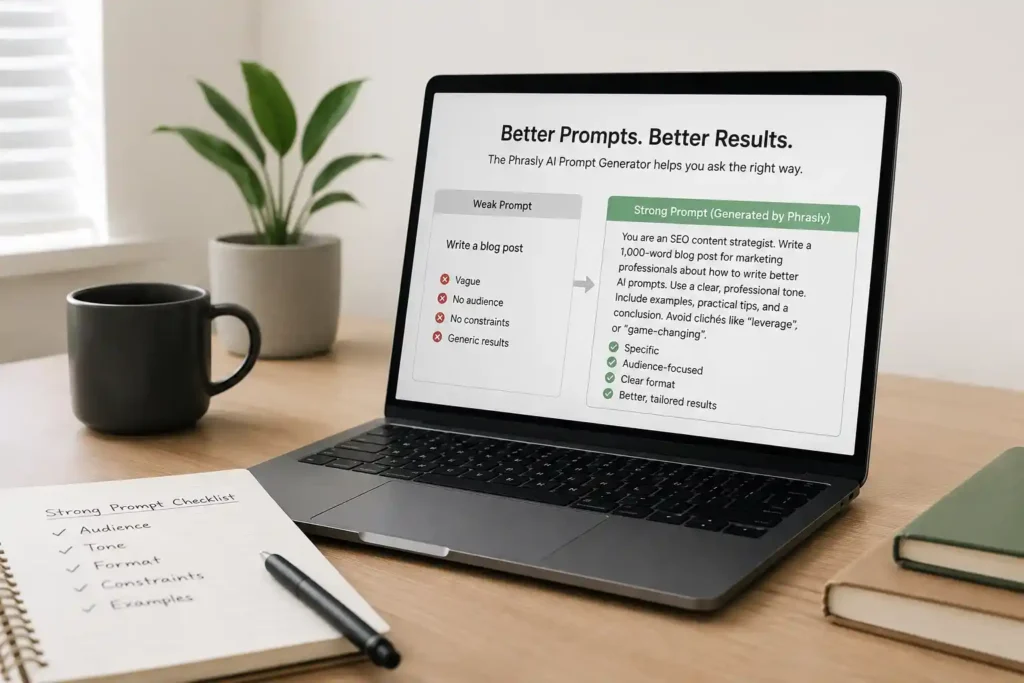

How the Phrasly AI Prompt Generator Helps You Get Better Results From ChatGPT and Other AI Tools
A 2024 McKinsey survey on AI adoption found that 65 percent of organizations now use generative AI regularly. That share nearly doubled in a single year. The same survey found that most organizations still struggle with consistency in AI output across teams.
That gap is not about the model. ChatGPT, Claude, and Gemini have all become significantly stronger in the past eighteen months. The gap is about how the question is being asked.
A well-built prompt does most of the work an AI model needs before it ever starts generating text. A weak prompt leaves the model guessing. This guide walks through what separates the two, why a prompt generator removes most of the guesswork, and how different professionals actually use these tools to get tighter, more useful output.
The Hidden Skill Most AI Users Are Missing
When professionals first try ChatGPT, the typical onboarding takes about ten minutes. Sign up, type a question, watch a long answer appear. The barrier to entry is the lowest of any productivity tool in years.
That ease of access masks the actual skill curve. Asking a good question is harder than the interface suggests. The instinct, especially for first-time users, is to type the way you would search Google. Short, keyword-driven, no context. The model returns something that reads competently and ships fast. It almost never reads tailored.
The harder skill, the one that separates regular users from people who get consistently strong output, is structured prompting. It is teachable. Most people just have not been taught.
How AI Actually Reads What You Type
A language model does not understand your prompt the way a colleague does. It has no context about your project, your industry, your audience, or your tone preferences. What it does have is the literal text you give it, and statistical patterns learned from billions of words of training data.
That means three things drive output quality.
Specificity.
The more detail you give about what you want, the smaller the space the model has to guess in. Vague prompts return vague output. Precise prompts return precise output. This is the single biggest lever most users do not pull.
Role framing.
When you tell the model who it is, it draws on different patterns. “You are an SEO content strategist” produces different output than “You are a high school English teacher,” even for the same question. The frame changes what the model reaches for.
Constraints.
Telling the model what NOT to include is often as useful as telling it what to include. “Do not use the words leverage, unlock, or elevate” instantly removes AI defaults from the output. Most users skip this and wonder why everything sounds the same.
A prompt generator handles all three by design.
How Different Professionals Actually Use Prompts
The structural skeleton of a strong prompt looks the same across roles. What varies is the substance. A useful way to understand prompt quality is to look at how the same model gets used by different professionals, and where it tends to break down when prompts are weak.
| Profession | Primary AI Use | What a Strong Prompt Includes | What Goes Wrong Without It |
| Marketer | Campaign copy, social, email | Audience, tone, channel constraints, brand voice rules | Generic copy that sounds like every competitor |
| Writer or journalist | First drafts, interview questions, outlines | Specific angle, voice samples, banned phrases | AI-cliché output, weak structure |
| Researcher or analyst | Summaries, literature reviews, data interpretation | Source neutrality, structured headings, citation format | Confident-sounding but unreliable claims |
| Founder or executive | Investor updates, internal memos, hiring | Audience seniority, document type, key data points | Generic templates that miss the actual ask |
| Operations | SOPs, process docs, training materials | Step-by-step format, role of reader, examples | Surface-level descriptions that miss edge cases |
The pattern across roles is the same. Strong prompts include audience, format, and constraints. Weak prompts leave them out.
The Phrasly AI Prompt Generator, In Practice
The reason most professionals do not build structured prompts every time is straightforward. The structure is easy to describe and harder to remember at 4 p.m.
The Phrasly AI prompt generator handles the structural part for you. The tool returns a fully formed prompt ready to paste into ChatGPT, Claude, Gemini, or any model you use.
The point is not that you cannot write prompts yourself. You can. The point is that you should not have to do it from scratch every single time. Once the structure is reliable, your attention shifts to the substance, which is the part where your judgement actually matters.
Use-Case Specific Prompting
Different professional contexts reward different prompt shapes. A sales follow-up email needs warmth and concision. A research summary needs neutrality and structured headings. A product description needs voice and conversion focus. The same five-part structure carries across them, but the variables inside change a lot.
For professionals working across multiple use cases, a deeper read on what actually works is useful. Phrasly’s piece on ChatGPT prompts for professionals breaks down specific examples for marketing, sales, research, and operations roles, with the patterns to include and the ones to cut.
The short version is that there is no universal prompt. There is a universal prompt structure, and then there are professional variations layered on top of it.
A Quick Test for Whether Your Prompts Are Strong
After you get an output from any AI model, run it through three questions.
Could a competitor have produced this same output?
If yes, your prompt was generic. The model defaulted to its average output instead of producing something tailored to you.
Does the output sound like your brand or your voice?
If not, you did not include enough constraints. Voice has to be specified, not assumed.
Did you have to rewrite more than 30 percent of it?
If yes, the prompt was missing structural pieces. The model was guessing on the parts you should have specified.
Get the desired answers on all three and your prompts are doing their job. Even one miss usually points back to a fixable prompt issue, not a model issue.
What Strong Prompts Do Not Solve
A prompt generator helps you write better questions. It does not write better answers on your behalf.
Judgement still belongs to you. Whether your topic angle is fresh, whether the data you cite is accurate, whether your final draft sounds true to your reader. None of that is delegable to the prompt. The AI returns what your prompt asks for. The decision about what to ask for, and what to keep, is still a human job.
The professionals who get the most out of AI have stopped expecting the model to do their thinking. They use it to handle formatting, structuring, and the first draft. The thinking lives upstream of the prompt.
Closing
The competitive edge in AI usage in 2026 is not which model you use. It is how you ask. Most people are still typing prompts the way they typed Google searches in 2015. A handful have learned to use the model the way they would brief a junior copywriter, with audience, voice, format, and constraints upfront.
Those people are not faster than everyone else by accident. They are faster because the prompt is doing most of the work before the AI ever starts.
A prompt generator removes the structural friction so you can focus on what matters. The substance. The voice. The decision about what is worth saying in the first place.