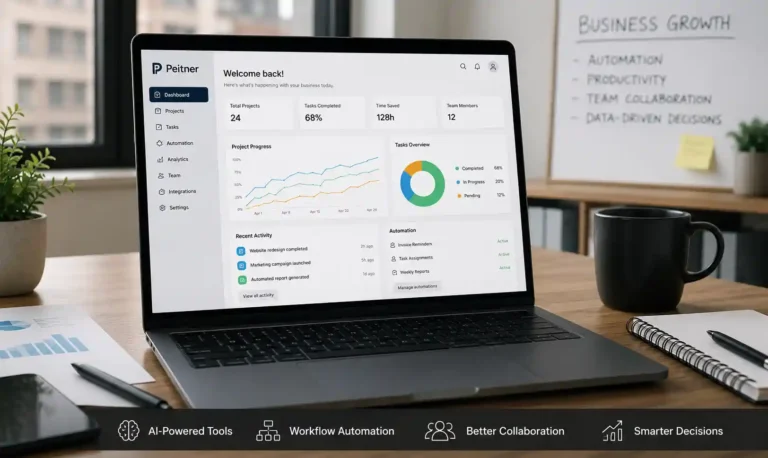


How AI Automation Tools Are Transforming Modern Businesses
AI automation tools are software solutions that combine artificial intelligence with automation to complete tasks with minimal human intervention. These tools analyze data, learn from patterns, and make decisions that improve workflows. Businesses use them to streamline operations, reduce repetitive work, and deliver faster, more accurate results. From customer service to marketing and finance, AI automation has become an essential part of modern business strategies.
Definition and Core Technology
AI automation tools rely on technologies such as machine learning, natural language processing, computer vision, and predictive analytics. These technologies allow systems to recognize patterns, interpret text or images, and continuously improve performance. Unlike basic software that follows fixed instructions, AI-powered solutions adapt to changing data and optimize outcomes over time. This ability makes them valuable for handling complex business processes efficiently.
How AI Automation Differs from Traditional Automation
Traditional automation follows predefined rules and executes repetitive tasks exactly as programmed. It cannot adapt to unexpected situations without manual updates. AI automation, however, learns from historical and real-time data, making intelligent decisions based on changing conditions. This flexibility enables businesses to automate more complex processes, improve accuracy, and respond quickly to evolving customer and market demands.
How AI Automation Tools Work
AI automation tools collect data from multiple sources, analyze it, and perform actions based on insights. They continuously learn from outcomes to improve future performance. Whether processing customer inquiries or managing workflows, these tools reduce manual effort while increasing speed and consistency across business operations.
Machine Learning and Data Processing
Machine learning algorithms analyze large datasets to identify trends and predict outcomes. As more data becomes available, the system improves its accuracy without requiring constant programming. AI automation tools use this capability to detect patterns, classify information, forecast demand, and automate repetitive tasks. Effective data processing ensures businesses make informed decisions based on reliable insights instead of guesswork.
Workflow Automation and Decision-Making
Workflow automation connects different business applications and automates tasks across departments. AI evaluates incoming information, prioritizes actions, and determines the next steps based on predefined goals and learned patterns. For example, an AI system can automatically assign support tickets, approve routine requests, or recommend inventory purchases. This intelligent decision-making reduces delays while improving operational efficiency.
Key Benefits of AI Automation for Businesses

Businesses adopt AI automation tools because they increase efficiency, reduce costs, and enhance customer satisfaction.
Increased Productivity and Efficiency
AI automation completes repetitive tasks much faster than manual processes. Employees spend less time entering data, organizing files, or responding to routine inquiries. Instead, they can focus on creative problem-solving, business development, and customer relationships. Improved productivity enables organizations to accomplish more with existing resources while maintaining consistent quality across operations.
Cost Savings and Error Reduction
Automating repetitive tasks reduces labor costs and minimizes expensive human errors. AI systems perform calculations, process transactions, and manage workflows with high accuracy. Fewer mistakes lead to lower operational expenses, reduced compliance risks, and improved business performance. Over time, organizations achieve a stronger return on investment by optimizing resources and reducing unnecessary manual work.
Enhanced Customer Experience
AI automation improves customer interactions through faster responses, personalized recommendations, and consistent service availability. Businesses can analyze customer behavior to deliver relevant products, targeted promotions, and proactive support. Quick issue resolution and personalized experiences increase customer satisfaction, strengthen loyalty, and encourage long-term relationships that contribute to sustainable business growth.
Common Types of AI Automation Tools
Organizations use different AI automation tools depending on their goals. Some focus on customer communication, while others improve marketing performance or streamline internal workflows. Selecting the right solution depends on business size, objectives, and operational requirements.
AI Chatbots and Virtual Assistants
AI chatbots and virtual assistants provide instant responses to customer questions around the clock. They handle common inquiries, schedule appointments, process requests, and guide users through products or services. By reducing response times and supporting customer service teams, these tools improve user satisfaction while lowering operational workloads.
Marketing Automation Platforms
Marketing automation platforms use AI to manage campaigns, segment audiences, personalize content, and analyze performance. They help businesses send targeted emails, optimize advertising strategies, and predict customer behavior. AI-driven insights improve campaign effectiveness, increase engagement, and maximize marketing return on investment through smarter decision-making.
Process Automation and Workflow Tools
Process automation tools streamline repetitive business activities by integrating multiple applications into a unified workflow. AI enhances these systems by identifying bottlenecks, recommending improvements, and automating approvals or document processing. As organizations grow, these tools improve operational consistency, increase scalability, and support faster decision-making across departments, making AI automation a valuable investment for long-term business success.
Industries Benefiting from AI Automation
AI automation has transformed industries by improving efficiency, reducing costs, and enhancing decision-making. As AI technologies continue to evolve, businesses are discovering new opportunities to improve productivity and maintain a competitive advantage.
Healthcare
Healthcare providers use AI automation to improve patient care, manage medical records, and support clinical decision-making. AI-powered systems analyze patient data, detect health patterns, and assist doctors in diagnosing diseases more accurately. Hospitals also automate appointment scheduling, billing, and administrative tasks, allowing healthcare professionals to spend more time caring for patients. These improvements increase efficiency while reducing operational burdens.
Finance and Banking
Financial institutions rely on AI automation to process transactions, detect fraud, assess credit risks, and improve customer support. Intelligent systems monitor unusual activities in real time, helping prevent financial losses and strengthen security. Banks also use AI-powered chatbots and automated document verification to accelerate customer onboarding while maintaining regulatory compliance and improving service quality.
E-commerce and Retail
E-commerce businesses use AI automation to personalize shopping experiences, recommend products, manage inventory, and optimize pricing strategies. AI analyzes customer behavior to deliver relevant product suggestions and targeted promotions. Retailers also automate order processing, inventory tracking, and customer support, ensuring faster deliveries and improved customer satisfaction while reducing operational costs.
Manufacturing
Manufacturers use AI automation to optimize production lines, predict equipment maintenance, and improve quality control. Smart systems monitor machinery, identify potential failures before breakdowns occur, and reduce unexpected downtime. AI also supports inventory management and supply chain optimization, helping manufacturers increase productivity, minimize waste, and improve overall operational efficiency.
You might also like: AI-Powered Workflow Automation for Growing Companies
Essential Features to Look for in AI Automation Tools
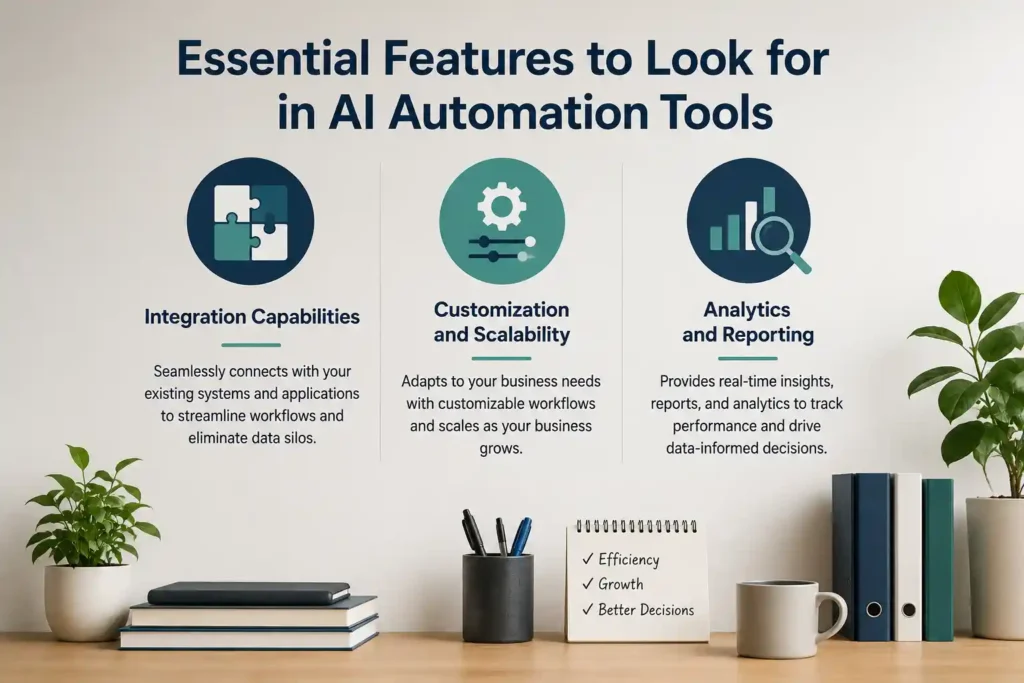
Selecting the right AI automation tool requires evaluating features that support long-term business growth. Effective solutions should integrate with existing systems, adapt to changing requirements, and provide valuable insights that help organizations make informed business decisions.
Integration Capabilities
AI automation tools should connect seamlessly with existing software, including customer relationship management platforms, accounting systems, marketing applications, and cloud services. Strong integration eliminates data silos, reduces manual data entry, and creates efficient workflows across departments. Businesses benefit from consistent information sharing and improved collaboration between different operational systems.
Customization and Scalability
Every organization has unique requirements, making customization an essential feature. AI automation tools should allow businesses to modify workflows, automate specific processes, and configure settings according to operational needs. Scalability is equally important because organizations need solutions that continue performing effectively as transaction volumes, users, and business operations expand over time.
Analytics and Reporting
Comprehensive analytics and reporting features help organizations measure automation performance and identify opportunities for improvement. AI-generated dashboards provide insights into productivity, customer engagement, workflow efficiency, and operational costs. These reports support data-driven decision-making, enabling businesses to optimize processes and maximize the value of their AI investments.
Challenges and Limitations of AI Automation
Although AI automation delivers significant advantages, businesses should also understand its limitations. Successful implementation requires addressing security concerns, managing investment costs, and preparing employees to work effectively alongside intelligent technologies.
Data Privacy and Security Concerns
AI systems often process large volumes of sensitive customer and business information. Organizations must implement strong cybersecurity measures, encryption, and access controls to protect confidential data. Compliance with privacy regulations also remains essential to maintain customer trust and avoid legal penalties associated with data breaches.
Implementation Costs and Complexity
Deploying AI automation may require significant investments in software, infrastructure, integration, and employee training. Smaller businesses can face challenges when upgrading legacy systems or customizing automation platforms. Careful planning, phased implementation, and realistic budgeting help organizations manage costs while reducing project complexity and minimizing operational disruptions.
Employee Training and Adoption
Employees need proper training to understand AI automation tools and integrate them into daily workflows. Without adequate support, resistance to change may reduce adoption and limit expected benefits. Providing continuous education, practical guidance, and clear communication helps teams develop confidence while encouraging collaboration between human expertise and AI-driven processes.
Best Practices for Implementing AI Automation
Successful AI automation depends on strategic planning rather than simply adopting new technology. Organizations should focus on business goals, monitor performance regularly, and continuously refine automation strategies to maximize long-term value.
Identify High-Impact Processes
Begin by identifying repetitive, time-consuming tasks that consume valuable employee resources. Prioritize processes with measurable business impact, such as customer support, invoice processing, inventory management, or data entry. Starting with high-value workflows allows organizations to achieve faster results while building confidence in AI automation initiatives.
Choose the Right AI Solution
Evaluate AI automation platforms based on business objectives, integration capabilities, ease of use, scalability, and vendor support. Compare available features carefully and select solutions that align with current requirements while supporting future growth. Choosing appropriate technology reduces implementation risks and improves long-term operational success.
Monitor Performance and Optimize
AI automation should be continuously monitored using performance metrics, employee feedback, and customer insights. Regular analysis identifies inefficiencies, improves workflows, and enhances decision-making accuracy. Businesses that consistently optimize their AI systems achieve stronger productivity, better customer experiences, and sustainable competitive advantages in rapidly evolving markets.
Popular AI Automation Tools for Businesses
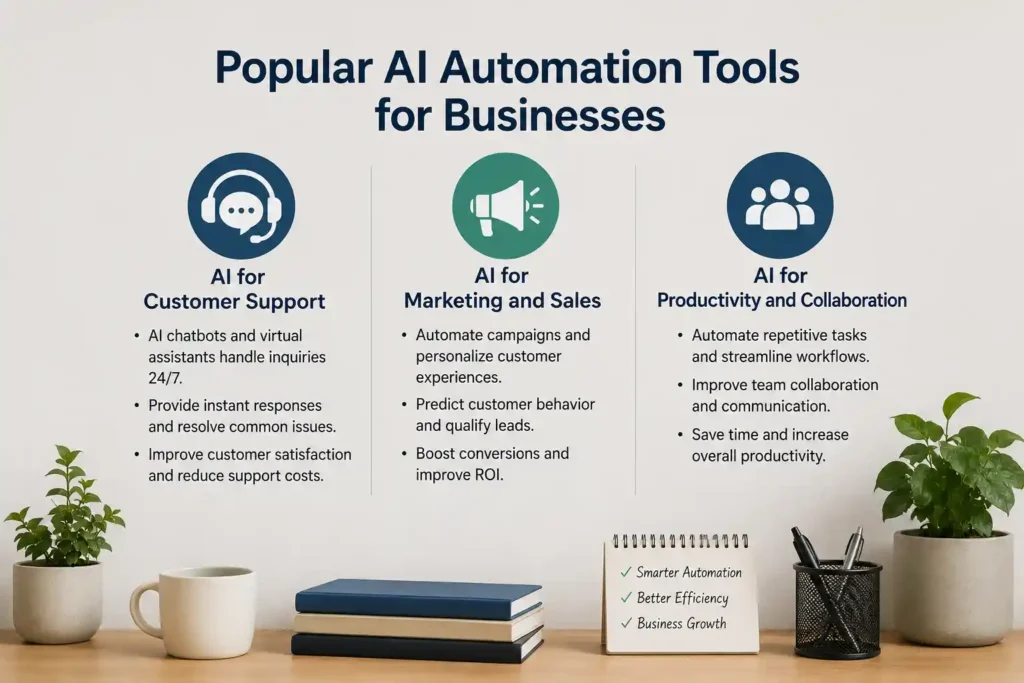
Businesses use AI automation tools to improve customer service, optimize marketing campaigns, and increase workplace productivity. These solutions automate repetitive tasks, generate valuable insights, and help teams make faster decisions. Choosing the right AI tools depends on business objectives, industry requirements, and the complexity of daily operations.
AI for Customer Support
AI-powered customer support tools include chatbots, virtual assistants, and automated help desks that provide instant responses around the clock. They answer common questions, resolve simple issues, and direct complex requests to human agents when necessary. By reducing response times and improving service consistency, these tools enhance customer satisfaction while lowering operational costs. They also collect customer insights that help businesses refine products, services, and communication strategies over time.
AI for Marketing and Sales
Marketing and sales teams use AI automation to personalize campaigns, qualify leads, predict customer behavior, and optimize advertising performance. AI analyzes customer interactions to recommend products, create targeted promotions, and improve conversion rates. Automated email campaigns, lead scoring, and sales forecasting enable businesses to reach the right audience with relevant messaging while maximizing marketing efficiency and revenue growth.
AI for Productivity and Collaboration
AI productivity tools simplify project management, automate scheduling, summarize meetings, organize documents, and improve team communication. Intelligent assistants reduce administrative workloads by handling repetitive office tasks, allowing employees to focus on strategic work. Collaboration platforms powered by AI also improve knowledge sharing and workflow coordination, creating more efficient and connected workplaces.
Future Trends in AI Automation
AI automation continues evolving rapidly as businesses adopt more intelligent technologies. Future innovations will expand automation capabilities, improve decision-making, and create smarter business operations across industries. Organizations that embrace these trends will be better positioned to remain competitive in an increasingly digital marketplace.
Generative AI in Business Operations
Generative AI is transforming business operations by creating text, images, reports, software code, and other digital content with minimal human effort. Companies use it to accelerate content creation, automate documentation, improve customer communication, and support product development. As the technology advances, generative AI will become an essential tool for improving efficiency and fostering innovation.
Hyperautomation and Intelligent Workflows
Hyperautomation combines artificial intelligence, robotic process automation, machine learning, and advanced analytics to automate entire business processes. Instead of focusing on individual tasks, organizations automate complete workflows across departments. Intelligent workflows reduce manual intervention, improve operational visibility, and increase overall business agility while delivering consistent and accurate outcomes.
Predictive Analytics and Autonomous Systems
Predictive analytics enables businesses to forecast trends, identify risks, and anticipate customer needs using historical and real-time data. Autonomous systems extend these capabilities by making routine decisions without constant human supervision. Together, these technologies improve resource planning, supply chain management, customer engagement, and operational efficiency while supporting faster, data-driven business decisions.
Frequently Asked Questions
What are AI automation tools?
AI automation tools are software solutions that combine artificial intelligence with automation technologies to perform repetitive tasks, analyze information, and make intelligent decisions with limited human involvement. They improve efficiency, reduce manual workloads, and support better business performance across various industries.
Which businesses benefit the most from AI automation?
Businesses of all sizes and industries benefit from AI automation. Healthcare providers, financial institutions, retailers, manufacturers, logistics companies, and professional service firms commonly use AI to improve productivity, enhance customer experiences, reduce operational costs, and make more informed decisions.
Are AI automation tools expensive?
Costs vary depending on features, business size, and implementation requirements. Many cloud-based AI automation platforms offer affordable subscription plans for small businesses, while enterprise solutions require larger investments. The long-term efficiency gains and productivity improvements often justify the initial expense.
Can small businesses use AI automation tools?
Yes. Many AI automation tools are designed specifically for small businesses and startups. Affordable cloud-based platforms allow smaller organizations to automate customer support, marketing, scheduling, invoicing, and other routine processes without investing in expensive infrastructure or large technical teams.
Is AI automation secure?
Most reputable AI automation platforms include strong security features such as encryption, access controls, regular updates, and compliance with industry standards. Businesses should also implement cybersecurity best practices and monitor data protection policies to minimize potential risks and maintain customer trust.
Conclusion
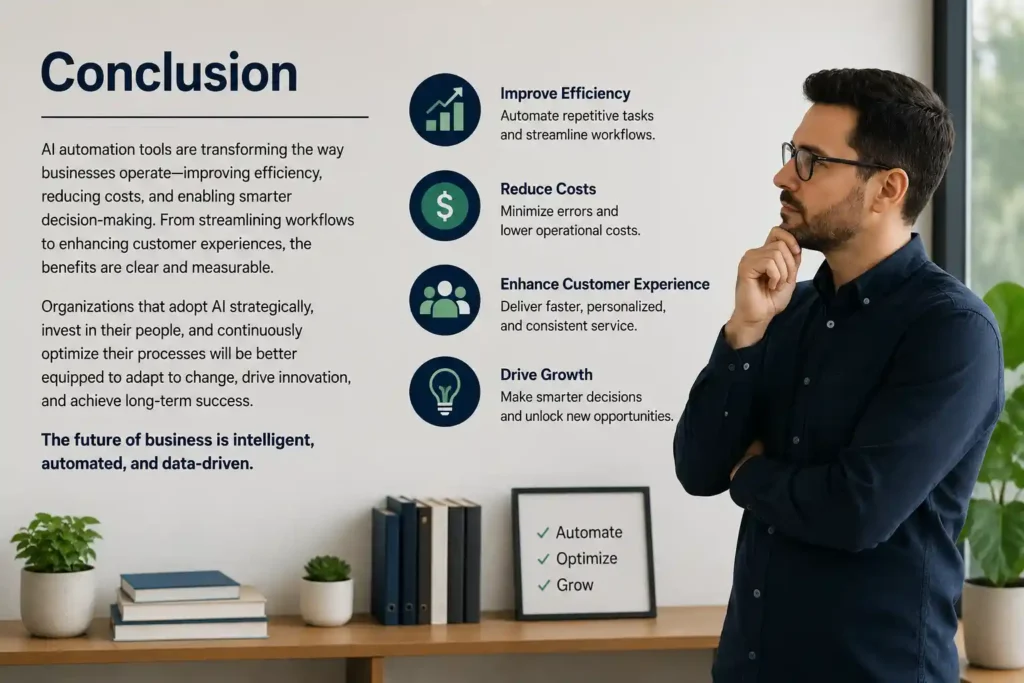
AI automation tools are reshaping modern businesses by improving efficiency, reducing costs, and supporting smarter decision-making. From customer service and marketing to productivity and predictive analytics, these technologies create meaningful opportunities for sustainable growth. Organizations that adopt AI strategically, invest in employee readiness, and continuously optimize their automation initiatives will be better equipped to adapt to changing market demands and achieve long-term success.
You might also like: The Rise of AI Automation in Modern Work Environments