
Future of Generative AI in Software Development
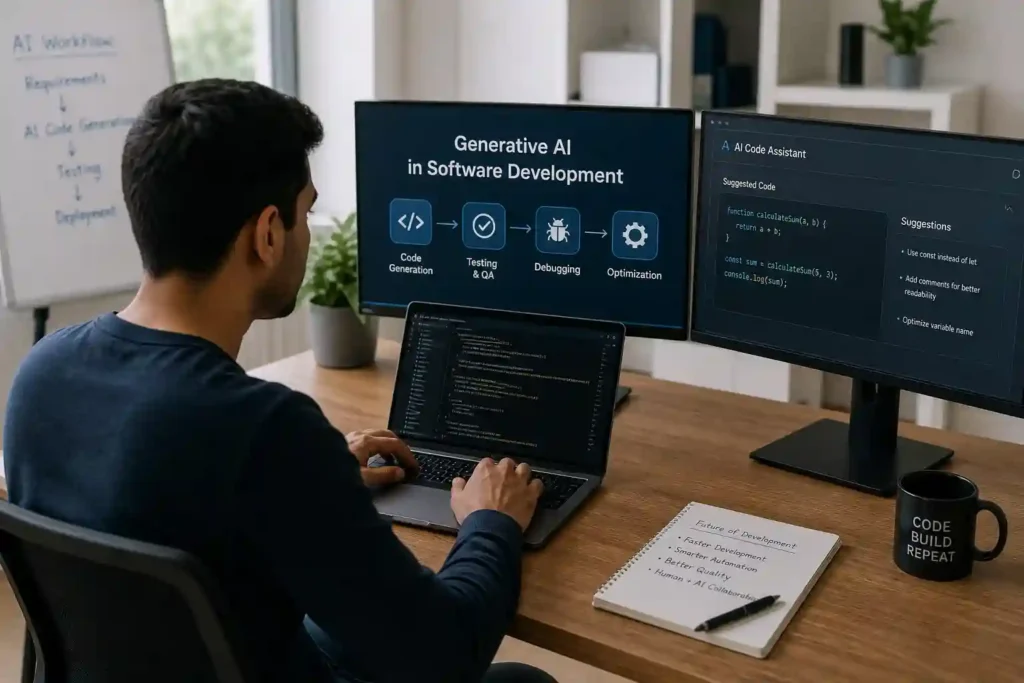
Generative AI is rapidly changing how software is built, tested, and maintained. It refers to AI systems that can create new content, such as code, text, or images, based on learned patterns from large datasets. In software development, it helps developers write code faster, reduce errors, and improve overall productivity.
What generative AI means in simple terms
Generative AI is a type of artificial intelligence that can produce new outputs instead of just analyzing existing data. In coding, it can generate functions, suggest fixes, or even build complete applications based on simple instructions written in natural language.
Why is it transforming the software industry?
The software industry is evolving because generative AI reduces time-consuming manual work. Developers can now focus more on logic and design rather than repetitive coding tasks. This shift increases efficiency and allows faster delivery of software products.
Evolution of AI in Software Engineering
Artificial intelligence has gradually become a core part of software engineering. It started as simple automation tools and has now evolved into advanced systems capable of writing and improving code.
From manual coding to AI-assisted development
Earlier, developers had to write every line of code manually. Today, AI tools assist by suggesting code snippets, completing functions, and even generating entire modules. This has significantly reduced development time.
Key breakthroughs in AI coding tools
Tools like AI-powered code assistants and machine learning-based compilers have revolutionized programming. These systems learn from millions of code repositories and continuously improve their suggestions, making development smarter and more efficient.
You might also like: AI-Powered SaaS Tools Are Transforming Small Businesses
How Generative AI Writes and Improves Code
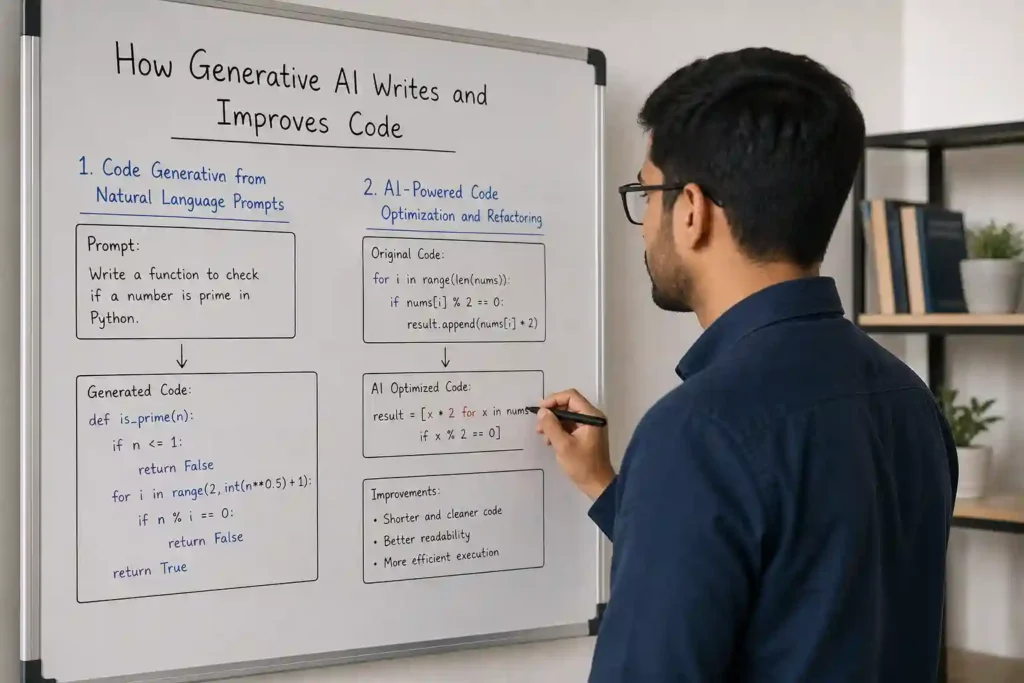
Generative AI is not just about writing code; it also improves existing code structures. It helps developers create cleaner, faster, and more efficient applications.
Code generation from natural language prompts
One of the most powerful features of generative AI is its ability to convert plain English instructions into working code. A developer can simply describe a function, and the AI generates the corresponding programming logic in seconds.
AI-powered code optimization and refactoring
Generative AI also improves existing code by optimizing performance and restructuring inefficient patterns. It identifies redundant lines and suggests better alternatives, making applications faster and more scalable.
Role of AI in Debugging and Error Handling
Debugging is one of the most time-consuming parts of software development. Generative AI has significantly improved this process by identifying and fixing errors automatically.
Automated bug detection systems
AI-powered tools can scan large codebases and detect bugs before they cause major issues. These systems analyze patterns and highlight potential vulnerabilities, helping developers fix problems early in the development cycle.
Real-time error correction and suggestions
Modern AI tools provide real-time feedback while coding. If a developer makes a mistake, the system immediately suggests corrections or alternative solutions, reducing downtime and improving code quality.
Impact on Software Development Workflow
Generative AI is significantly reshaping how modern software teams operate. From planning to deployment, AI tools are streamlining workflows that were once slow and heavily manual. Developers are now able to deliver high-quality software in less time while maintaining better consistency across projects.
Faster development cycles
One of the biggest impacts of generative AI is the acceleration of development cycles. Tasks that once required hours or even days, such as writing boilerplate code or setting up project structures, can now be completed in minutes. AI-powered systems help developers generate code templates, suggest logic structures, and even auto-complete complex functions. This speed allows companies to release products faster, respond quickly to market changes, and maintain a competitive edge in the tech industry.
Reduced manual effort in coding tasks
Generative AI also reduces the need for repetitive manual coding. Developers no longer need to write every line from scratch, especially for standard functions or repetitive modules. Instead, AI tools handle these tasks, allowing developers to focus on problem-solving, architecture, and feature innovation. This shift not only improves efficiency but also reduces mental fatigue and human error in large-scale projects.
You might also like: Build a Fully Automated Online Business Using AI Tools
AI in Software Testing and Quality Assurance
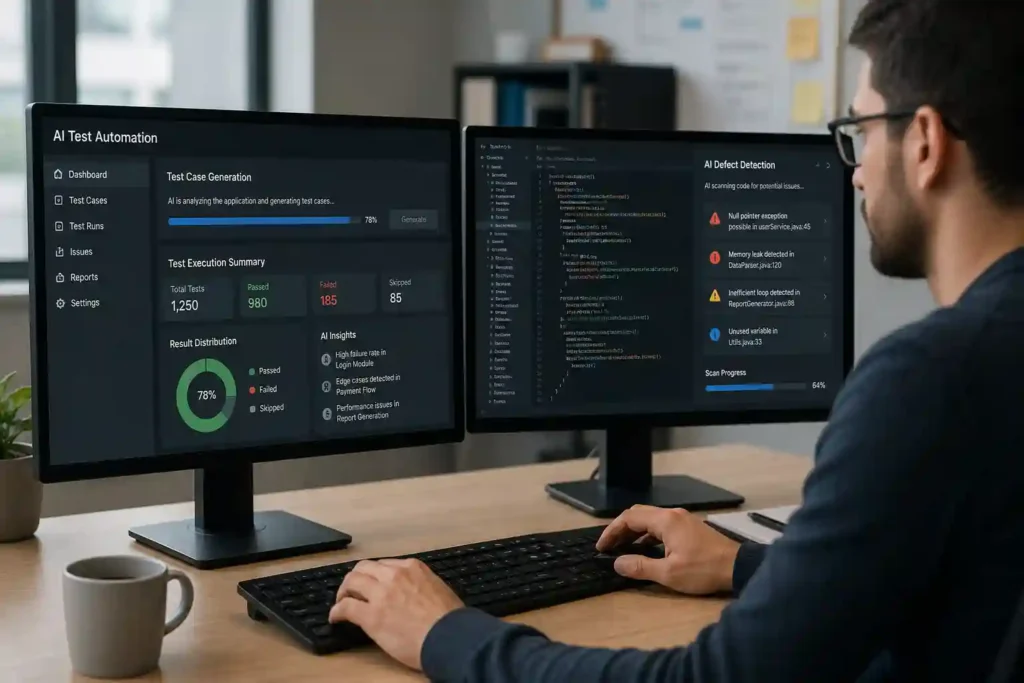
Generative AI is making these processes more intelligent, faster, and more reliable by automating test creation and improving prediction accuracy.
Automated test case generation
AI systems can now automatically generate test cases based on the application’s code and functionality. Instead of manually writing hundreds of test scenarios, developers can rely on AI tools to create comprehensive test coverage. These tools analyze the codebase and identify possible use cases, edge cases, and failure points.
Predictive testing for better reliability
Beyond automation, generative AI also enables predictive testing. By analyzing historical data, previous bugs, and system behavior, AI can predict where future failures might occur. This helps teams focus their testing efforts on high-risk areas, improving software reliability. Predictive testing also reduces unnecessary testing cycles, saving both time and computational resources.
Popular Generative AI Tools for Developers
The rise of generative AI has led to the development of powerful tools that are now widely used in software engineering. These tools are integrated into development environments and cloud platforms, making them easily accessible to developers worldwide.
AI coding assistants and IDE integrations
Modern AI coding assistants are embedded directly into integrated development environments (IDEs). These assistants help developers write code faster by suggesting completions, detecting errors, and offering optimization tips in real time. Tools like these act as intelligent collaborators, reducing friction in the coding process and improving overall productivity.
Cloud-based AI development platforms
Cloud-based AI platforms are another major innovation in software development. These platforms provide scalable environments where developers can build, test, and deploy applications with AI support. They offer features such as automated deployment pipelines, AI-driven analytics, and collaborative coding environments. This makes development more flexible and accessible, especially for distributed teams working remotely.
Benefits of Generative AI in Development
The adoption of generative AI in software development brings numerous advantages. It is not just improving how code is written but also transforming how entire development teams operate.
Increased productivity and efficiency
Generative AI allows developers to accomplish more in less time. Automating repetitive tasks and assisting with complex coding challenges, it significantly boosts productivity. Teams can focus on innovation rather than routine tasks, leading to faster project completion and improved software quality.
Lower development costs for businesses
Another major benefit is cost reduction. With AI handling a large portion of coding, testing, and debugging tasks, companies can reduce the need for large development teams. This leads to lower operational costs without compromising quality. Additionally, faster development cycles mean quicker time-to-market, which can increase revenue opportunities for businesses.
You might also like: Smart Ways to Automate Daily Business Tasks with AI
Challenges and Risks of Generative AI
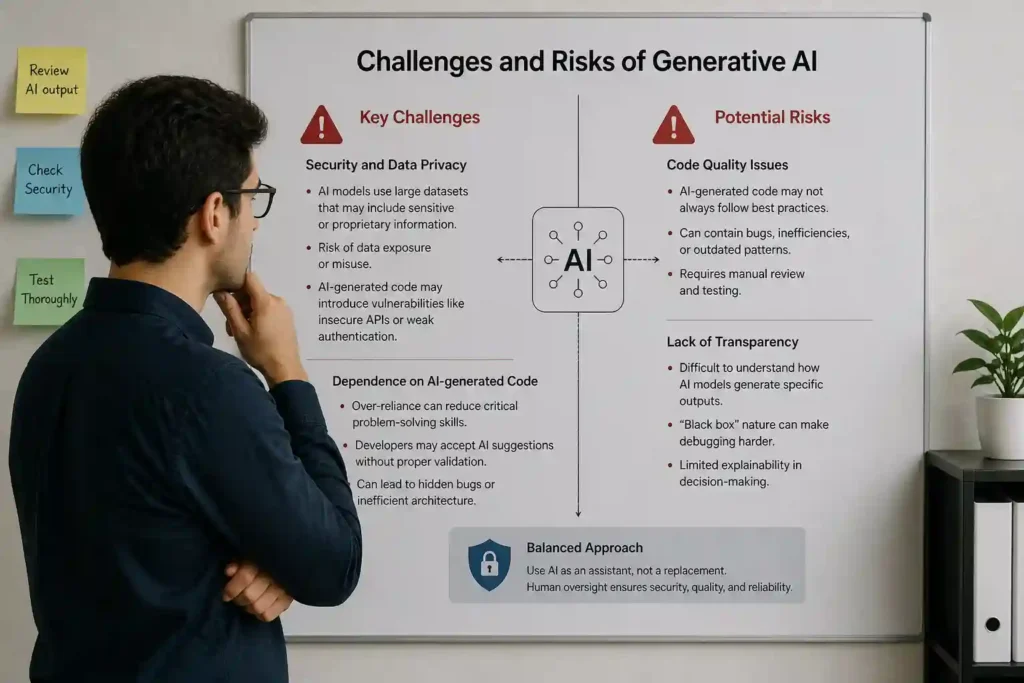
While generative AI is transforming software development, it also introduces several challenges that cannot be ignored. Organizations adopting AI must carefully balance innovation with risk management to ensure long-term stability and security.
Security and data privacy concerns
One of the biggest risks of generative AI is data security. AI models often rely on large datasets, which may include sensitive or proprietary information. If not properly managed, this data can be exposed or misused. Additionally, AI-generated code may unintentionally introduce vulnerabilities such as insecure APIs or weak authentication logic. Developers must carefully review AI outputs to ensure compliance with security standards and privacy regulations.
Dependence on AI-generated code
Another major concern is over-reliance on AI tools. When developers depend too heavily on AI-generated code, they may lose critical problem-solving skills over time. This can reduce their ability to understand complex systems deeply. In some cases, teams may accept AI suggestions without proper validation, leading to hidden bugs or inefficient architecture. A balanced approach is necessary where AI acts as an assistant, not a replacement.
Future of Software Developers in the AI Era
As generative AI becomes more advanced, many professionals wonder how it will affect software development careers. The role of developers is not disappearing, but it is evolving into something more strategic and creative.
Will AI replace software engineers?
AI is unlikely to fully replace software engineers. Instead, it is reshaping their responsibilities. Routine coding tasks are increasingly automated, but human expertise is still essential for system design, decision-making, and understanding business requirements. Developers will shift from writing every line of code to supervising AI systems, refining outputs, and ensuring software aligns with real-world needs.
New skill sets developers need to learn.
To stay relevant, developers must adapt to new skill requirements. Understanding how to work with AI tools, write effective prompts, and evaluate AI-generated outputs is becoming essential. Additionally, skills in system architecture, cybersecurity, and AI ethics are gaining importance. Developers who combine traditional programming knowledge with AI proficiency will have a strong advantage in the future job market.
Real-World Applications of Generative AI
Generative AI is no longer just a concept; it is actively being used across industries to build and scale real products. Both startups and large enterprises are integrating AI into their development processes.
Startup product development with AI
Startups are leveraging generative AI to build minimum viable products (MVPs) quickly and cost-effectively. With AI-assisted coding tools, small teams can develop functional applications in a fraction of the time it used to take. This allows startups to test ideas faster, iterate based on user feedback, and bring products to market with limited resources.
Enterprise automation and scaling systems
Large enterprises are using generative AI to automate complex development workflows and scale their systems efficiently. AI helps manage large codebases, automate testing, and optimize cloud infrastructure. This reduces operational overhead and improves system reliability. Enterprises also use AI-driven analytics to monitor performance and predict potential system failures before they occur.
You might also like: Future of Remote Work Technology and Digital Innovation
FAQs on Generative AI in Software Development
What is generative AI in software development?
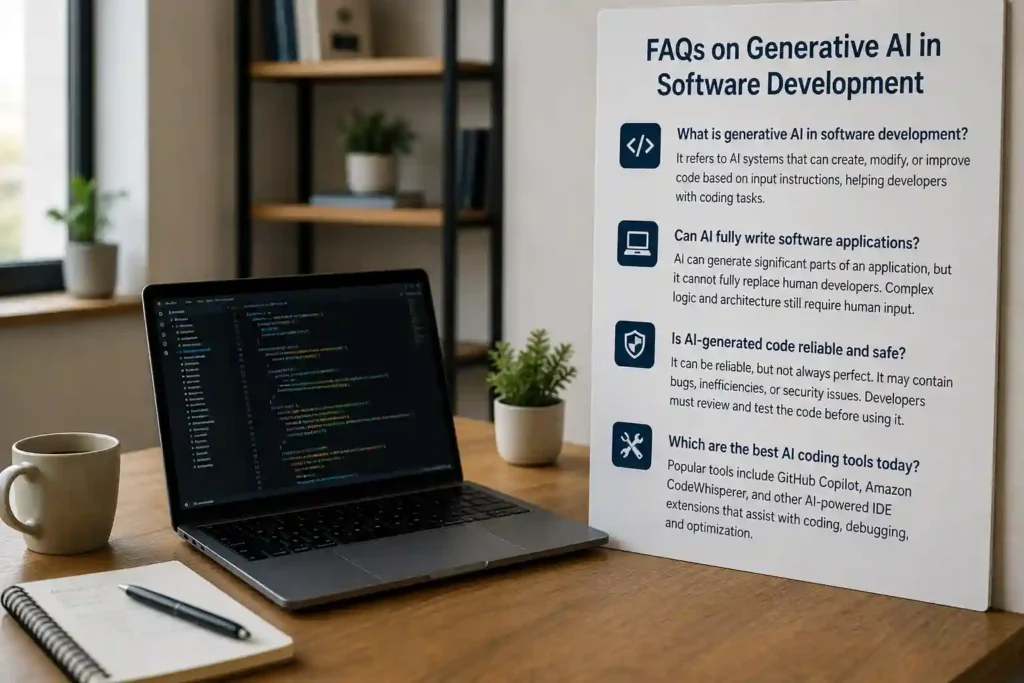
Generative AI in software development refers to AI systems that can create, modify, or improve code based on input instructions. It helps developers by generating functions, suggesting improvements, and automating repetitive coding tasks.
Can AI fully write software applications?
AI can generate significant parts of an application, but it cannot fully replace human developers. Complex logic, architecture design, and business understanding still require human input and oversight.
Is AI-generated code reliable and safe?
AI-generated code can be reliable, but it is not always perfect. It may contain bugs, inefficiencies, or security issues. Developers must review and test AI-generated outputs before deploying them in production environments.
Which are the best AI coding tools today?
Some of the most popular AI coding tools include GitHub Copilot, Amazon CodeWhisperer, and various AI-powered IDE extensions. These tools assist developers with code generation, debugging, and optimization.
Conclusion
Generative AI is reshaping the future of software development by improving productivity, accelerating innovation, and automating repetitive tasks. However, it also introduces challenges such as security risks and over-dependence on automation. The future of development lies in collaboration between humans and AI, where developers guide intelligent systems rather than being replaced by them. Those who adapt to this shift and learn how to effectively use AI tools will remain highly valuable in the evolving tech landscape.