
A Complete Guide to Choosing an AR & VR Development Company in India
If you have been thinking about building an AR or VR application for your business, you are not alone. More and more companies across India are exploring immersive technology, from retail brands wanting to offer virtual try-ons, to manufacturers looking to improve workforce training, to real estate developers giving buyers virtual property tours.
But here is where many businesses get stuck: they do not know how to find a reliable AR VR app development company in India, what questions to ask, or how to avoid wasting money on the wrong partner.
This guide answers all of that, simply and clearly. By the end, you will know exactly what AR and VR can do for your business, what to look for in a development company, and how to get started without confusion.
Understanding AR, VR, and MR
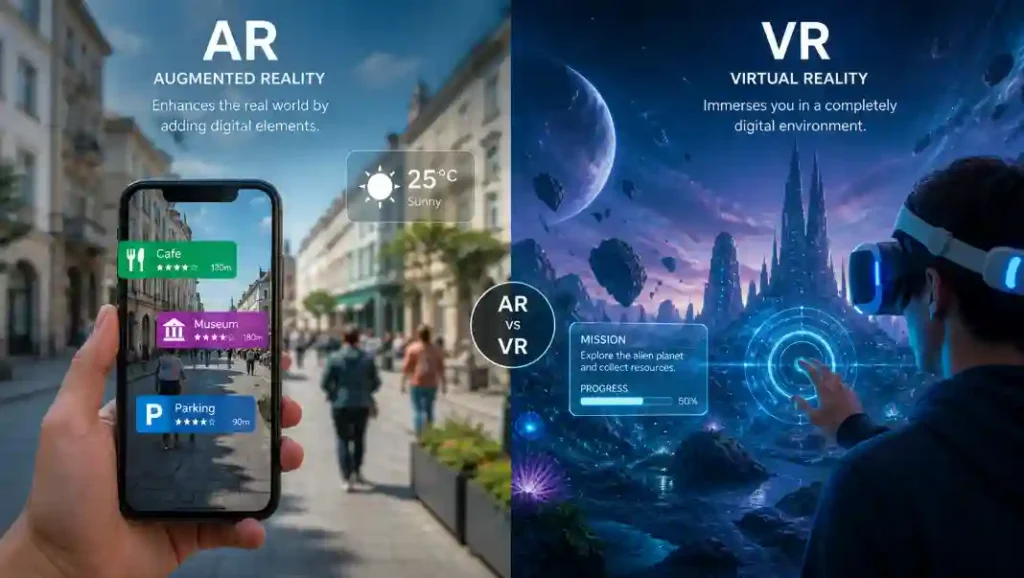
A lot of people use AR and VR interchangeably, but they are quite different. Understanding the difference helps you know which one your business actually needs.
Augmented Reality (AR)
AR adds digital content on top of the real world. Your phone camera stays on. You still see your surroundings, but digital objects, text, or animations appear layered over them. Think of apps that let you see how a sofa looks in your living room before buying it, or a training app that shows assembly instructions projected onto actual machinery.
Virtual Reality (VR)
VR replaces the real world entirely. You put on a headset and enter a fully digital environment. Everything you see is computer-generated. VR is widely used for training simulations, virtual property tours, surgical practice, and immersive gaming.
Mixed Reality (MR)
MR is a step beyond AR. Not only does it add digital objects to your real environment, but those digital objects actually interact with the physical world around them. A holographic instruction manual that responds to the real machine in front of you is a good example. MR hardware like Microsoft HoloLens is used in advanced industrial and medical applications.
What Can AR and VR Do for Your Business?
Here are the most common and proven ways businesses in India are using AR and VR right now:
- Retail and E-Commerce
Customers cannot physically touch products when shopping online, which leads to hesitation and high return rates. AR fixes this by letting shoppers virtually try on clothes, test how furniture looks in their room, or preview products at actual scale on their phone. Businesses using AR in e-commerce consistently see better conversion rates and fewer returns.
- Employee Training
Training new employees, especially in complex or hazardous environments, is time-consuming and risky. VR allows workers to practice in realistic simulations before touching real equipment. A factory worker can run through an assembly process dozens of times in a VR environment before their first day on the floor. Training time drops. Errors drop. Confidence goes up.
- Real Estate and Architecture
Selling a property that is still under construction is hard when buyers cannot visit it. VR walkthroughs let buyers explore every room of an apartment or office space as if they were physically inside, before a single wall has been built. Architects also use VR to present designs to clients in a far more compelling way than blueprints ever could.
- Healthcare
Medical students and surgical residents use VR to practice procedures in a zero-risk environment. AR tools are also being used to assist surgeons during operations by overlaying imaging data directly into their field of view. These applications improve outcomes and accelerate skill development.
- Marketing and Brand Experiences
Brands are using AR to make their marketing interactive. Product packaging that comes alive through a phone camera, AR-powered showrooms, and virtual event experiences are all ways companies are using immersive technology to stand out and create memorable moments that drive engagement.
Why Choose an AR VR Development Company in India?
India has become one of the world’s top destinations for AR and VR development, and it is not just about lower costs. Here is why smart businesses around the world choose Indian development partners:
Large pool of specialized talent, India produces thousands of skilled engineers, 3D artists, and UX designers with hands-on XR experience every year.
Cost advantage, Development costs in India are typically 50 to 70 percent lower than in the US or UK, without any drop in quality.
Strong English communication, Indian development teams communicate clearly in English, making collaboration smooth for both domestic and global clients.
Proven delivery track record, Indian software companies have been delivering complex technology projects for global clients for decades.
Growing XR expertise, As India’s domestic AR/VR market grows rapidly, Indian developers are gaining real-world deployment experience across retail, healthcare, manufacturing, and more.
For Indian businesses, working with a local AR VR company means finding a partner who understands your market, your users, and your operational context, making the collaboration faster and more effective.
How to Choose the Right AR VR App Development Company in India
This is where most businesses need the most help. The AR/VR development market in India includes companies of vastly different quality and capability. Here is a simple checklist to help you choose wisely:
Check Whether XR Is Their Core Focus
Some companies offer AR/VR as one of the thirty services they provide. Others are genuinely specialized in immersive technology. The difference in depth and quality is significant. Look for companies where AR, VR, and XR development is clearly a primary offering, not an afterthought added to a generalist portfolio.
Review Their Portfolio Carefully
A good development company will describe outcomes in business terms, reduced return rates, faster training completion, and higher engagement. If their portfolio only talks about technical features and not business results, that is a red flag.
Ask About Their Full Technology Capability
AR and VR development covers a broad technical stack, 3D modeling, real-time rendering, computer vision, platform SDKs, integration with enterprise systems, and more. Ask potential partners which platforms they work with, which engines they use, and how they handle integration with your existing systems. A capable company will answer these questions confidently and specifically.
Understand How They Manage Projects
Good development companies operate with transparent, structured processes. They should be able to explain how they manage projects, how often they communicate updates, how they handle changes in requirements, how they test quality, and what their post-launch support looks like. If a company cannot clearly explain its process, that is worth noting.
Start with a Discovery Conversation
Before committing to a project, have a detailed discovery conversation. A good AR/VR development partner will ask you smart questions about your business objectives, your users, and the outcomes you need. If a company jumps straight to pricing without understanding your goals, they are treating your project as a transaction rather than a partnership.
Look for Flexibility in Engagement
Different projects suit different commercial arrangements. Some projects have a clear fixed scope and suit a fixed-price contract. Others are exploratory and benefit from a time-and-materials approach. Some businesses want a dedicated team embedded in their workflow long-term. A reliable development company will offer options and recommend the right fit for your situation.
Questions to Ask Before You Sign Anything
Here are practical questions to ask any AR VR development company before you commit:
What AR/VR platforms and development engines do you work with?
How do you handle integration with existing systems like CRM or ERP?
What does your quality assurance and testing process look like?
Which devices and operating systems will the app be tested on?
What does post-launch support look like, and what are the SLA terms?
How do you handle scope changes during the project?
Can you provide references from previous clients?
A company that answers these questions clearly and confidently without deflecting or giving vague responses is one worth working with.
Common Mistakes Businesses Make When Starting an AR/VR Project
Knowing what to avoid is just as important as knowing what to look for. Here are the most common mistakes businesses make:
- Focusing on the Technology Instead of the Problem
The biggest mistake is starting with “we want an AR app” rather than “we want to reduce product return rates” or “we want to cut training time by 40%.” Always start with the business problem. The technology is the solution, not the goal.
- Choosing the Cheapest Option
AR and VR development done poorly is expensive because you end up paying to rebuild it. An application that crashes, runs slowly, or delivers a poor user experience reflects badly on your brand and fails to deliver the outcomes you invested in. Choose quality and track record over the lowest quote.
- Skipping the UX Design Phase
Immersive technology demands specialist user experience design. The rules of mobile or web UX do not directly apply to AR or VR. Skipping or rushing the design phase leads to applications that are technically functional but uncomfortable, confusing, or exhausting to use. Invest in proper spatial UX design from the start.
- Not Planning for Maintenance
AR and VR applications need ongoing maintenance as operating systems update, SDK versions change, and new devices are released. Build post-launch support into your budget and our contract from day one, not as an afterthought after something breaks.
How Avantari Technologies Can Help
Avantari Technologies is a dedicated AR VR app development company in India, focused entirely on building immersive technology solutions that deliver real business outcomes.
We work with businesses across retail, healthcare, manufacturing, real estate, education, and marketing, helping them build AR apps, VR training platforms, Mixed Reality tools, and XR solutions that actually move the needle on the metrics that matter to them.
What makes us different is simple: we treat every project as a business problem first, and a technology challenge second. And we stay with you after launch to make sure the solution continues to perform.
Whether you are exploring AR for the first time or looking to scale an existing XR initiative, we are happy to have an honest conversation about what is possible, what it would cost, and how long it would take, with no pressure and no jargon.
Conclusion
Choosing an AR VR app development company in India does not have to be complicated. Focus on specialization, proven results, clear communication, and a partner who understands your business goals, not just your technical requirements.
AR and VR technology is accessible, affordable, and delivering measurable results for businesses of all sizes right now. The question is not whether immersive technology is right for your business. For most industries, it clearly is. The question is whether you have the right partner to help you achieve your goals. If you are ready to take the next step, Avantari Technologies is here to help. Reach out for a free discovery call and let us explore what AR or VR could do for your business.