

AI Development Platforms Helping Businesses Build Smarter Systems
AI development platforms are software environments that help businesses create, train, deploy, and manage artificial intelligence applications. These platforms combine essential tools, frameworks, and services into a single workspace, allowing developers and organizations to build AI-powered solutions without starting from scratch. They support various AI technologies, including machine learning, natural language processing, computer vision, and predictive analytics.
The core purpose of an AI development platform is to simplify the development process while reducing time, costs, and technical complexity. Instead of manually setting up infrastructure, businesses can use built-in tools for data preparation, model training, testing, and deployment. Many modern platforms also include automation features that improve productivity and ensure consistent performance across projects.
As AI adoption continues to grow, these platforms have become valuable resources for organizations seeking smarter ways to solve business challenges, improve customer experiences, and make data-driven decisions.
How They Support AI Application Development
AI development platforms streamline every stage of the application lifecycle. They provide prebuilt algorithms, development environments, and cloud-based resources that allow teams to create intelligent applications faster. Developers can access datasets, train models, evaluate performance, and deploy AI solutions through a unified interface.
Many platforms also support collaboration by enabling data scientists, software engineers, and business teams to work together on the same project. Automated workflows reduce repetitive tasks, while integrated testing tools help identify issues before deployment. As a result, businesses can launch reliable AI applications more efficiently while maintaining high standards of quality and scalability.
Why Businesses Are Investing in AI Development Platforms
Improving Operational Efficiency
Businesses are increasingly investing in AI development platforms because they help automate routine processes and improve overall efficiency. AI-powered systems can analyze large volumes of data, identify patterns, and perform repetitive tasks with greater speed and accuracy than manual methods. This allows employees to focus on strategic activities that require creativity and decision-making.
For example, organizations use AI platforms to automate customer service, optimize inventory management, detect fraud, and streamline document processing. These improvements reduce operational costs while increasing productivity. Faster workflows also help businesses respond quickly to market demands and customer expectations.
Accelerating Digital Transformation
Digital transformation has become a priority for organizations across industries, and AI development platforms play a central role in that journey. These platforms enable companies to integrate artificial intelligence into existing systems without rebuilding their entire technology infrastructure.
Businesses can modernize operations by implementing AI-driven automation, predictive analytics, and intelligent decision support. Cloud-based deployment options make it easier to scale applications as business needs evolve. As organizations embrace digital innovation, AI development platforms provide the flexibility and speed needed to remain competitive in rapidly changing markets.
You might also like: AI Cybersecurity Tools Helping Companies Prevent Data Breaches
Key Features to Look for in an AI Development Platform
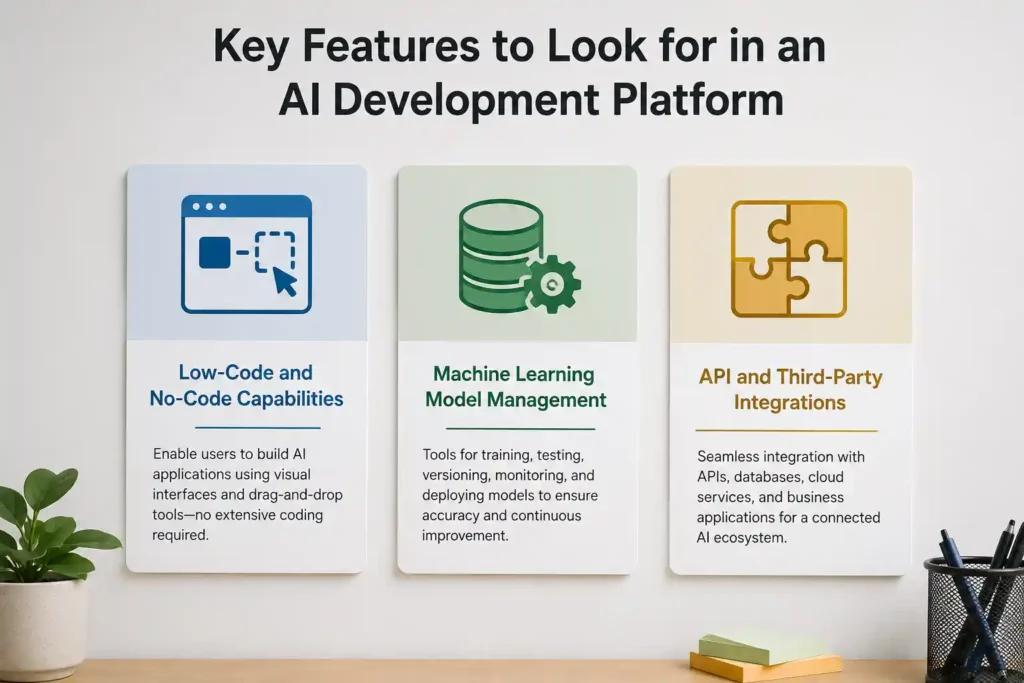
Low-Code and No-Code Capabilities
Low-code and no-code features allow users with limited programming experience to build AI applications using visual interfaces and drag-and-drop components. These capabilities reduce development time, encourage collaboration, and enable business teams to create AI solutions without relying entirely on software developers.
Machine Learning Model Management
Effective AI platforms include tools for managing machine learning models throughout their lifecycle. Features such as version control, automated training, performance monitoring, and model deployment help organizations maintain accuracy and continuously improve AI performance while simplifying maintenance.
API and Third-Party Integrations
Strong integration capabilities allow AI platforms to connect with existing business applications, cloud services, databases, and external software through APIs. Seamless integrations improve data sharing, support automation, and help organizations maximize the value of their current technology investments.
Types of AI Development Platforms
Cloud-Based AI Platforms
Cloud-based AI platforms provide scalable computing resources, managed infrastructure, and flexible deployment options. Businesses can develop and deploy AI applications without investing heavily in on-premises hardware, making cloud solutions cost-effective and easy to expand.
Open-Source AI Frameworks
Open-source AI frameworks give developers complete control over customization and experimentation. They offer extensive community support, regular updates, and flexibility for building specialized AI applications while reducing software licensing costs.
Enterprise AI Development Solutions
Enterprise AI development solutions are designed for large organizations that require advanced security, compliance, governance, and scalability. These platforms integrate with enterprise systems, support large development teams, and provide centralized management for complex AI initiatives, making them ideal for mission-critical business operations.
How AI Development Platforms Build Smarter Business Systems
Workflow Automation
AI development platforms help businesses automate repetitive and time-consuming tasks, making operations more efficient. They can streamline workflows by handling activities such as document processing, customer support, inventory tracking, and data entry with minimal human intervention. Automation reduces manual errors, speeds up task completion, and allows employees to focus on higher-value responsibilities. By integrating AI into everyday processes, organizations can improve productivity while maintaining consistent performance across departments.
Predictive Analytics
Predictive analytics is one of the most valuable capabilities offered by AI development platforms. Using historical and real-time data, AI models identify patterns and forecast future outcomes. Businesses can predict customer demand, detect equipment failures, estimate sales trends, and anticipate potential risks before they become serious problems. These insights help organizations make proactive decisions instead of reacting after issues arise. Accurate forecasting also supports better planning, resource allocation, and long-term business growth.
Intelligent Decision Support
AI development platforms strengthen decision-making by transforming large volumes of data into meaningful insights. Interactive dashboards, recommendation engines, and real-time analytics provide business leaders with actionable information that supports strategic planning. Instead of relying solely on intuition, organizations can make evidence-based decisions that improve operational efficiency, reduce uncertainty, and increase competitiveness. Intelligent decision support helps businesses respond faster to changing market conditions while improving overall performance.
You might also like: AI-Powered Workflow Automation for Growing Companies
Top Use Cases Across Industries
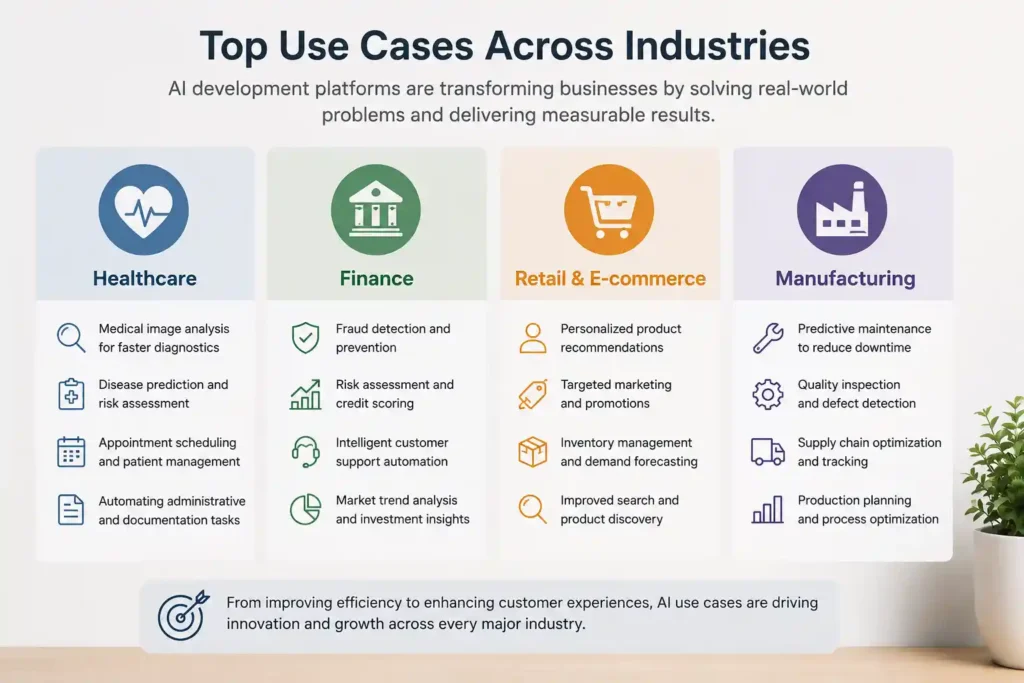
Healthcare
Healthcare organizations use AI development platforms to improve patient care and operational efficiency. AI-powered applications assist with medical image analysis, disease prediction, appointment scheduling, and personalized treatment recommendations. Hospitals also automate administrative tasks, reducing paperwork and allowing healthcare professionals to spend more time with patients. These solutions contribute to faster diagnoses, better outcomes, and more efficient healthcare delivery.
Finance
Financial institutions rely on AI development platforms for fraud detection, risk assessment, credit scoring, and automated customer service. Machine learning models continuously monitor transactions to identify suspicious activities in real time. AI also helps banks analyze market trends, improve investment strategies, and provide personalized financial recommendations. By automating complex financial processes, organizations enhance security while delivering faster and more accurate services.
Retail and E-commerce
Retailers use AI development platforms to personalize shopping experiences and optimize business operations. AI analyzes customer behavior to recommend relevant products, improve search results, and create targeted marketing campaigns. Businesses also use predictive analytics for inventory management and demand forecasting, ensuring popular products remain available while reducing excess stock. These capabilities increase customer satisfaction and support higher sales performance.
Manufacturing
Manufacturing companies implement AI development platforms to improve production efficiency and equipment reliability. Predictive maintenance systems monitor machinery and identify potential failures before breakdowns occur, minimizing downtime and repair costs. AI also supports quality inspection, supply chain optimization, and production planning. These improvements increase operational efficiency while maintaining consistent product quality across manufacturing processes.
Benefits of Using AI Development Platforms
Faster Development Cycles
AI development platforms provide prebuilt tools, templates, and automated workflows that reduce development time. Teams can quickly build, test, and deploy intelligent applications without creating every component from scratch. Faster development enables businesses to respond rapidly to changing customer demands and emerging market opportunities.
Better Scalability
Modern AI development platforms are designed to grow alongside business requirements. Organizations can expand applications, process larger datasets, and support increasing numbers of users without significant infrastructure changes. This flexibility ensures AI solutions remain effective as businesses continue to evolve.
Cost Optimization
Automation and efficient resource management help organizations reduce operational costs. AI minimizes repetitive manual work, improves productivity, and decreases expensive errors. Cloud-based platforms also eliminate many hardware expenses by providing scalable computing resources that businesses pay for only when needed.
Enhanced Customer Experiences
AI-powered chatbots, recommendation systems, and personalized services improve customer interactions across multiple channels. Businesses can deliver faster responses, tailored product suggestions, and consistent support that strengthen customer satisfaction and encourage long-term loyalty.
Common Challenges and How to Overcome Them
Data Quality Issues
AI systems depend on accurate and well-organized data. Poor-quality, incomplete, or inconsistent information can reduce model accuracy and produce unreliable results. Businesses should establish strong data governance practices, regularly clean datasets, and monitor data quality to ensure successful AI implementation.
Security and Compliance
Protecting sensitive business and customer information remains a major concern when deploying AI solutions. Organizations should implement encryption, access controls, continuous monitoring, and compliance policies that align with industry regulations. Strong security measures reduce risks while building customer trust.
Skills and Talent Gaps
Many organizations face challenges in finding professionals with AI expertise. Businesses can overcome this gap by investing in employee training, partnering with experienced technology providers, and adopting user-friendly AI development platforms with low-code capabilities. These strategies help teams build AI solutions more efficiently while reducing dependence on specialized technical skills.
You might also like: How Generative AI Is Reshaping Content Creation Online
How to Choose the Right AI Development Platform
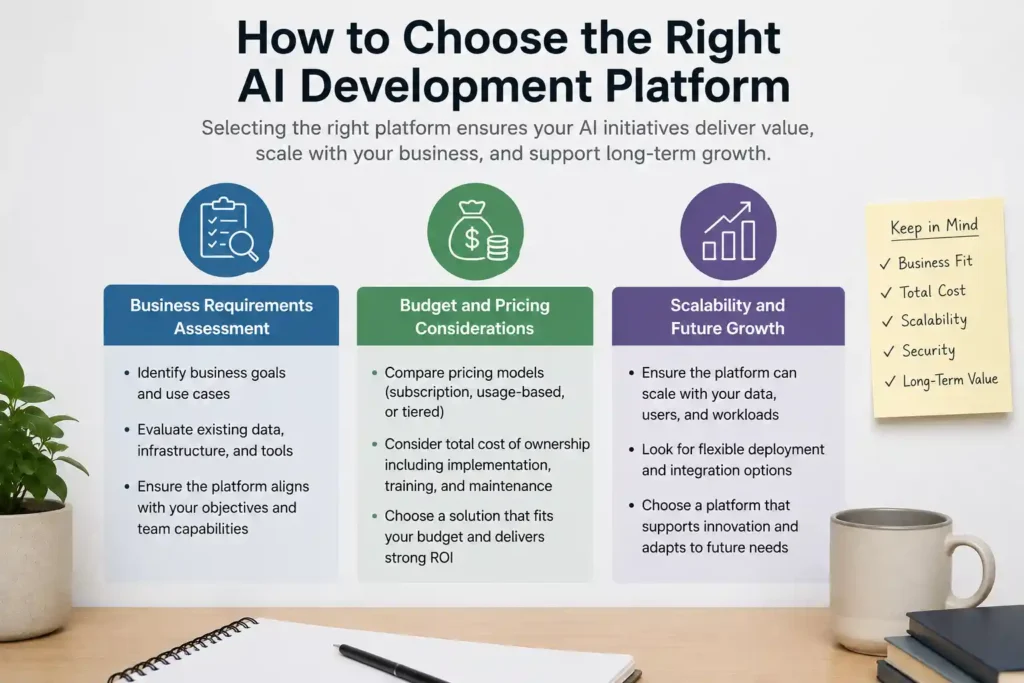
Business Requirements Assessment
Selecting the right AI development platform starts with understanding your organization’s goals and technical needs. Businesses should identify the problems they want AI to solve, whether improving customer service, automating workflows, analyzing data, or enhancing decision-making. Evaluating existing infrastructure, available data, and team expertise helps narrow platform options. A clear assessment ensures the chosen solution aligns with business objectives and delivers measurable value over time.
Budget and Pricing Considerations
Cost is another important factor when comparing AI development platforms. Some providers offer subscription-based pricing, while others charge based on computing resources, storage, or usage. Businesses should evaluate both initial and long-term expenses, including licensing, implementation, training, and maintenance. Choosing a platform that fits the available budget without sacrificing essential features helps maximize return on investment and prevents unexpected costs as AI adoption expands.
Scalability and Future Growth
An AI development platform should support future business growth without requiring major system changes. Scalable platforms can handle increasing data volumes, additional users, and more advanced AI models as organizational needs evolve. Flexible deployment options, strong integration capabilities, and regular feature updates ensure the platform remains valuable for years. Investing in a scalable solution reduces future migration costs and supports continuous innovation.
Best Practices for Successful AI Platform Implementation
Define Clear Business Objectives
Successful AI implementation begins with well-defined objectives. Organizations should establish measurable goals, such as reducing operational costs, improving customer satisfaction, or increasing productivity. Clear objectives guide development efforts, simplify performance evaluation, and help teams prioritize projects that deliver meaningful business outcomes. Without defined goals, AI initiatives may fail to produce measurable results or align with organizational priorities.
Start with Pilot Projects
Launching small pilot projects allows businesses to evaluate AI performance before large-scale deployment. Pilot programs help identify technical challenges, measure return on investment, and gather valuable feedback from users. Organizations can refine workflows, improve models, and build confidence before expanding AI across multiple departments. This gradual approach minimizes implementation risks while increasing the likelihood of long-term success.
Continuously Monitor and Improve Models
AI models require continuous monitoring to maintain accuracy and relevance. As business conditions and customer behavior change, model performance may decline if left unchanged. Organizations should regularly evaluate predictions, retrain models using updated data, and monitor key performance metrics. Continuous improvement ensures AI applications remain reliable, efficient, and aligned with changing business requirements.
Frequently Asked Questions
What is an AI development platform?
An AI development platform is a software environment that provides tools for building, training, deploying, and managing artificial intelligence applications. It simplifies AI development by combining data processing, machine learning, automation, and deployment capabilities into a single solution.
Which industries benefit the most from AI development platforms?
Healthcare, finance, manufacturing, retail, logistics, education, telecommunications, and customer service all benefit significantly from AI development platforms. These industries use AI to automate operations, improve decision-making, analyze data, and deliver better customer experiences while increasing efficiency.
Can small businesses use AI development platforms?
Yes. Many AI development platforms offer cloud-based services and low-code tools that make artificial intelligence accessible to small businesses. These solutions reduce infrastructure costs and allow smaller organizations to automate processes, improve customer engagement, and compete more effectively.
Are low-code AI platforms suitable for enterprise projects?
Low-code AI platforms can support enterprise projects when they provide strong security, scalability, integration capabilities, and governance features. Many organizations combine low-code development with professional customization to accelerate deployment while maintaining enterprise-level performance and compliance requirements.
How much do AI development platforms typically cost?
The cost varies depending on the provider, deployment model, computing resources, and included features. Some platforms offer affordable monthly subscriptions for small businesses, while enterprise solutions require customized pricing based on organizational size, infrastructure, and usage requirements.
You might also like: Novafork: The Future of Decentralized Development
Conclusion
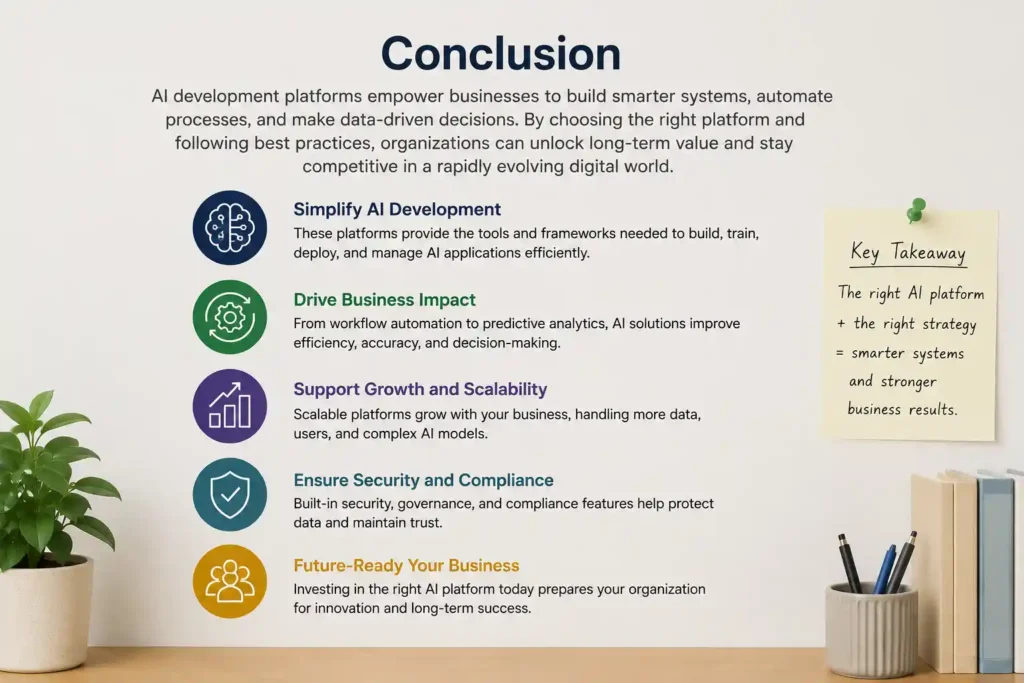
AI development platforms have become essential tools for organizations seeking smarter, faster, and more efficient business operations. They simplify AI application development, support automation, improve decision-making, and enable innovation across industries. By carefully assessing business needs, selecting a scalable platform, and following proven implementation practices, organizations can maximize the value of artificial intelligence while preparing for future growth. As AI technology continues to evolve, investing in the right development platform will help businesses remain competitive, adaptable, and ready to meet changing market demands with confidence.