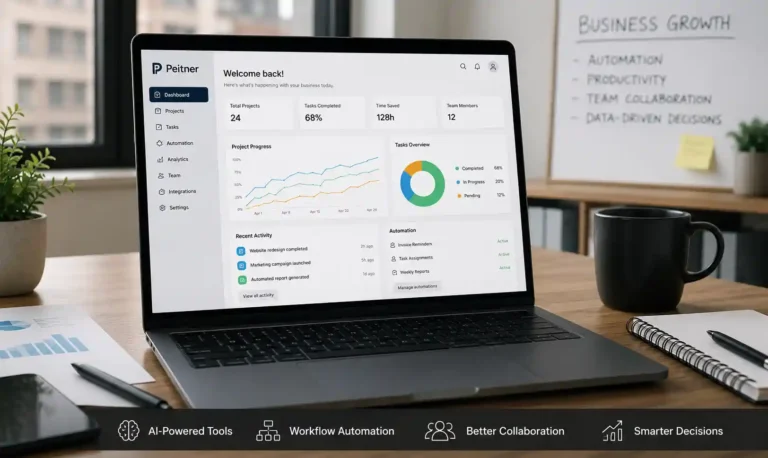
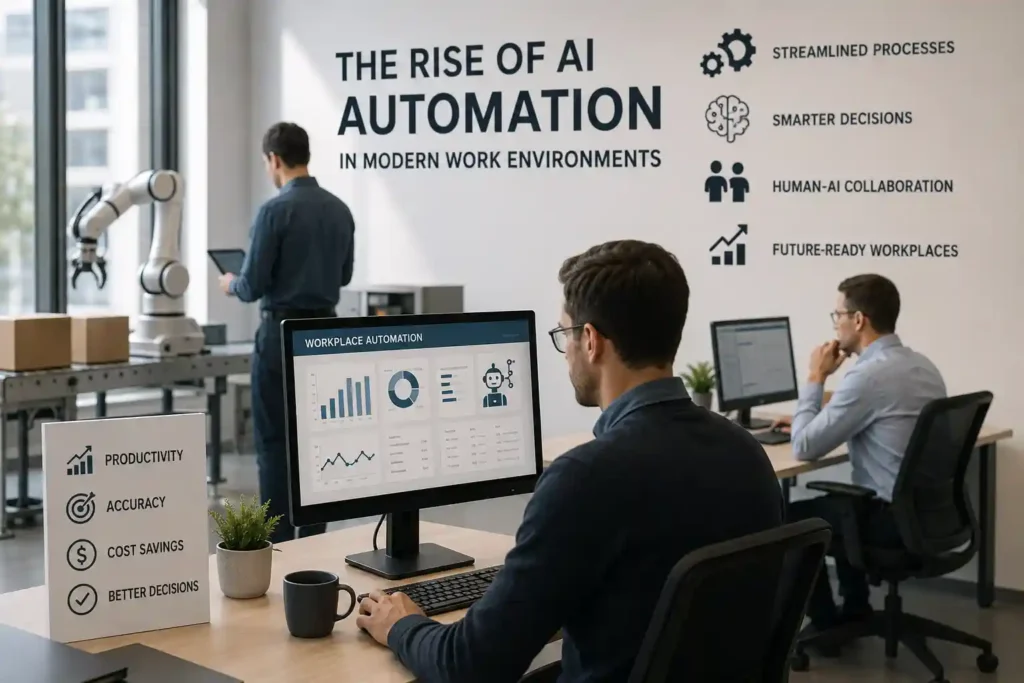

The Rise of AI Automation in Modern Work Environments
AI automation refers to the use of artificial intelligence to perform tasks that typically require human intelligence. Unlike traditional automation, which follows fixed rules, AI systems analyze data, learn from patterns, and make informed decisions. Businesses use AI automation to streamline operations, improve customer experiences, and reduce repetitive manual work. As organizations embrace digital transformation, AI automation has become an essential tool for increasing competitiveness and adapting to changing market demands across industries.
How AI Automation Works in the Workplace
AI automation combines machine learning algorithms, data analysis, and intelligent software to complete tasks efficiently. It gathers information from multiple sources, processes it, identifies trends, and performs actions with minimal human intervention. Employees benefit by spending less time on repetitive activities and more time on strategic work requiring creativity and problem-solving. Organizations also gain faster workflows, improved collaboration, and better operational consistency throughout departments and business functions.
Key Technologies Behind AI Automation
Several technologies power AI automation, including machine learning, natural language processing, computer vision, robotic process automation, and predictive analytics. Machine learning enables systems to improve through experience, while natural language processing helps computers understand human language. Computer vision interprets images and videos, whereas robotic process automation handles repetitive digital tasks. Together, these technologies create intelligent solutions that continuously improve workplace efficiency and business performance.
Evolution of AI in the Workplace
From Traditional Automation to Intelligent Systems
Traditional automation relied on predefined rules and repetitive programming. Modern AI systems go beyond fixed instructions by learning from data and adapting to new situations. This shift has transformed business operations, enabling organizations to automate increasingly complex processes while maintaining flexibility. Intelligent systems now support decision-making, customer engagement, and operational management in ways that were previously impossible using conventional automation technologies.
Major Milestones in AI Adoption
The adoption of AI has accelerated due to advances in computing power, cloud technology, and data availability. Businesses initially used AI for simple data analysis before expanding into predictive analytics, virtual assistants, and automated decision-making. The rise of generative AI has further expanded possibilities, allowing organizations to create content, summarize information, and enhance productivity. These milestones continue to reshape modern workplaces worldwide across diverse business sectors.
Industries Leading the AI Revolution
Healthcare, finance, manufacturing, retail, and logistics are among the industries driving AI innovation. Healthcare providers use AI for diagnostics and patient management, while financial institutions detect fraud and automate transactions. Manufacturers optimize production with predictive maintenance, retailers personalize customer experiences, and logistics companies improve route planning. These sectors demonstrate how AI automation delivers measurable value by increasing efficiency, reducing costs, and improving service quality.
You might also like: Voozon: AI-Powered Content & Productivity Solution
Benefits of AI Automation in Modern Work Environments
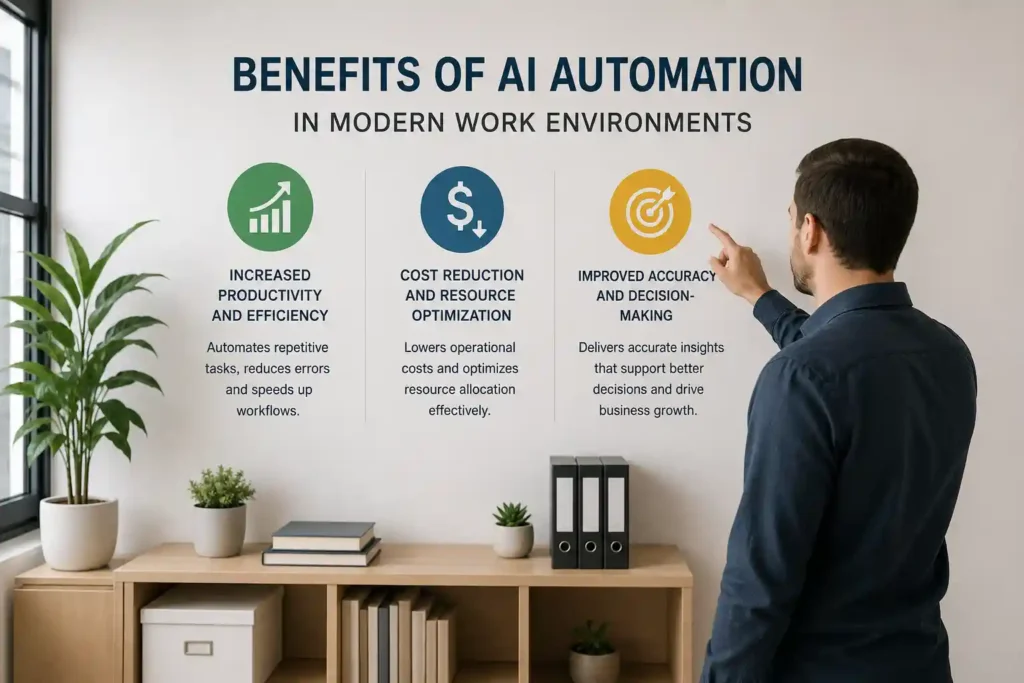
Increased Productivity and Efficiency
AI automation significantly improves productivity by completing repetitive tasks faster and with greater consistency than manual processes. Employees can dedicate more time to innovation, customer relationships, and strategic planning instead of routine administrative work. Faster workflows reduce delays, enhance collaboration, and enable organizations to respond quickly to market opportunities while maintaining high-quality performance across teams and departments.
Cost Reduction and Resource Optimization
Automating repetitive processes lowers operational expenses by reducing manual labor, minimizing errors, and optimizing resource allocation. AI also helps identify inefficiencies, allowing organizations to use equipment, time, and budgets more effectively. These savings create opportunities for investment in innovation, employee development, and long-term business growth.
Improved Accuracy and Decision-Making
AI systems analyze large datasets with remarkable speed and precision, reducing human error in routine operations. Real-time insights support informed decision-making by identifying patterns and predicting outcomes. Managers gain reliable information for planning, forecasting, and risk management. Improved accuracy strengthens customer satisfaction, operational reliability, and overall organizational performance in competitive business environments.
Common Applications of AI Automation
Customer Service and Chatbots
AI-powered chatbots provide instant responses, answer common questions, and offer round-the-clock customer support. They improve response times, increase customer satisfaction, and reduce workloads for service teams while ensuring consistent communication across multiple digital channels.
HR and Recruitment Automation
Human resources departments use AI to screen resumes, schedule interviews, and identify qualified candidates efficiently. Automation accelerates hiring, reduces administrative tasks, and improves recruitment accuracy while enhancing the candidate experience.
Marketing and Sales Automation
Marketing teams use AI to personalize campaigns, analyze customer behavior, and automate email marketing. Sales professionals benefit from predictive insights, lead scoring, and customer recommendations that increase conversion rates and strengthen long-term client relationships.
Finance and Accounting Processes
AI automates invoice processing, expense tracking, financial reporting, and fraud detection. These capabilities improve compliance, reduce manual errors, accelerate financial operations, and help organizations maintain accurate records while supporting better financial planning and business stability.
AI Automation Across Different Industries
Healthcare
AI automation is transforming healthcare by improving patient care, accelerating diagnosis, and streamlining administrative tasks. Intelligent systems analyze medical images, predict disease risks, and assist doctors in making informed decisions. Hospitals also use AI to automate appointment scheduling, patient record management, and billing processes. These improvements reduce operational delays, enhance treatment accuracy, and allow healthcare professionals to focus more on delivering quality patient care while increasing overall efficiency throughout healthcare organizations.
Manufacturing
Manufacturing companies use AI automation to optimize production, monitor equipment performance, and improve product quality. Predictive maintenance identifies machinery issues before failures occur, reducing downtime and repair costs. AI-powered robots perform repetitive tasks with precision, ensuring consistent production standards. Manufacturers also analyze operational data to improve supply chains, reduce waste, and maximize productivity. As a result, businesses achieve higher efficiency, lower operational costs, and increased competitiveness in global markets.
Retail and E-commerce
Retailers and e-commerce businesses leverage AI automation to personalize shopping experiences, manage inventory, and improve customer service. Recommendation engines suggest relevant products based on customer preferences, while AI forecasts demand to optimize stock levels. Automated pricing strategies help businesses remain competitive, and virtual shopping assistants enhance customer engagement. These capabilities increase customer satisfaction, improve sales performance, and strengthen long-term brand loyalty in highly competitive retail environments.
Education
Educational institutions are adopting AI automation to create personalized learning experiences and simplify administrative operations. AI-powered learning platforms adapt content based on student performance, helping learners progress at their own pace. Teachers benefit from automated grading, attendance tracking, and performance analysis, allowing more time for instruction and mentorship. Educational organizations also use AI to identify learning gaps, improve student engagement, and support data-driven academic planning for better educational outcomes.
You might also like: AI Development Platforms Helping Businesses Build Smarter Systems
Challenges and Risks of AI Automation
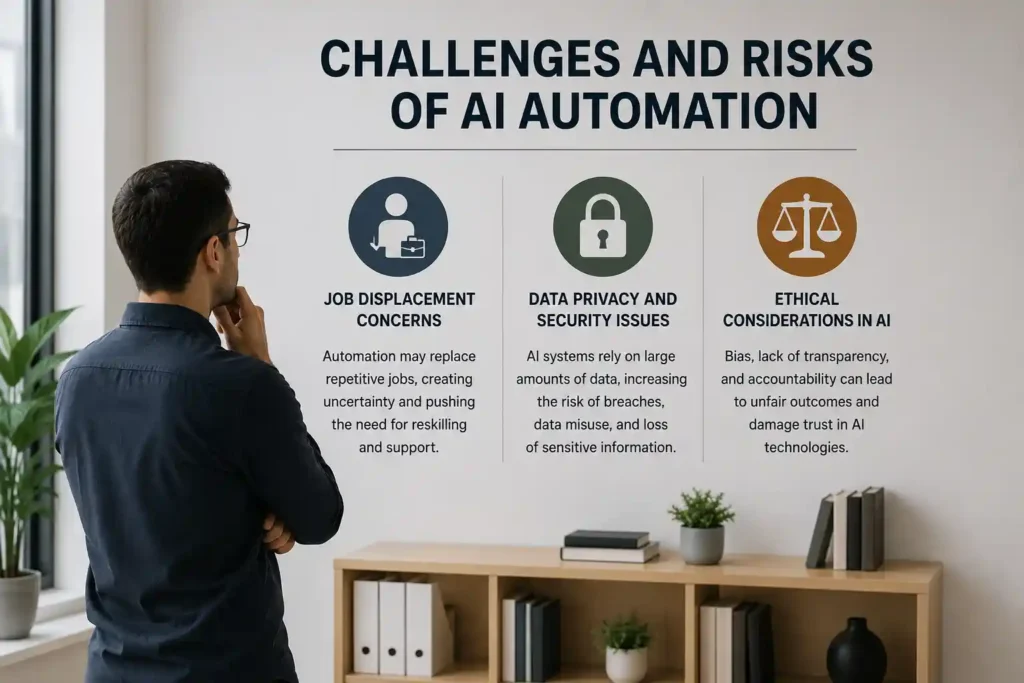
Job Displacement Concerns
One of the most discussed concerns surrounding AI automation is the potential displacement of jobs involving repetitive or routine tasks. While automation may reduce demand for certain positions, it also creates opportunities for new technology-focused roles. Organizations should prioritize workforce transition strategies by providing employees with training and career development programs. Supporting adaptation helps businesses maintain employee confidence while preparing teams for evolving workplace responsibilities.
Data Privacy and Security Issues
AI systems depend on large volumes of data, making privacy and cybersecurity critical concerns. Businesses must protect sensitive customer and organizational information from unauthorized access, cyberattacks, and data misuse. Implementing strong encryption, secure storage, and compliance with data protection regulations helps minimize risks. Regular security assessments and transparent data management practices strengthen trust while ensuring AI solutions operate responsibly and safely within modern business environments.
Ethical Considerations in AI
Ethical AI implementation requires fairness, transparency, and accountability. Organizations should prevent algorithmic bias by using diverse datasets and regularly evaluating AI outcomes. Decision-making processes must remain understandable, especially in areas affecting employees and customers. Establishing ethical guidelines and governance frameworks encourages responsible AI adoption while protecting stakeholder interests. Businesses that prioritize ethical standards build stronger reputations and foster greater confidence in AI-powered technologies.
The Impact of AI on Employees
Changing Job Roles
AI automation is reshaping job responsibilities by reducing repetitive work and increasing demand for analytical, creative, and strategic skills. Employees increasingly supervise automated systems, interpret AI-generated insights, and focus on higher-value activities. Rather than replacing human expertise entirely, AI changes how work is performed, encouraging professionals to develop skills that complement intelligent technologies and support organizational innovation.
Upskilling and Reskilling the Workforce
Continuous learning has become essential in AI-driven workplaces. Employers should invest in upskilling programs that teach digital literacy, data analysis, AI fundamentals, and problem-solving skills. Reskilling initiatives help employees transition into emerging roles while reducing uncertainty about workplace automation. A culture of lifelong learning strengthens workforce adaptability and prepares organizations for ongoing technological advancements.
Human-AI Collaboration
The greatest value of AI automation comes from collaboration between humans and intelligent systems. AI excels at processing data quickly, while people contribute creativity, empathy, judgment, and critical thinking. Combining these strengths enables better decision-making, enhanced customer experiences, and increased innovation. Organizations that encourage effective human-AI collaboration create balanced workplaces where technology supports employees instead of replacing them.
Best Practices for Implementing AI Automation
Identifying Suitable Processes
Successful AI implementation begins by identifying repetitive, time-consuming, and data-intensive processes suitable for automation. Businesses should evaluate operational challenges, define objectives, and prioritize projects that deliver measurable value. Starting with targeted initiatives reduces implementation risks while building organizational confidence in AI capabilities.
Choosing the Right AI Tools
Selecting appropriate AI solutions requires careful evaluation of business needs, scalability, integration capabilities, and vendor support. Organizations should choose tools that align with existing workflows and long-term strategic goals. Reliable AI platforms simplify deployment while maximizing operational efficiency and business performance.
Measuring ROI and Performance
Measuring return on investment ensures AI automation delivers meaningful business outcomes. Organizations should track productivity improvements, cost savings, process accuracy, customer satisfaction, and employee engagement. Regular performance evaluations identify optimization opportunities, enabling continuous improvement and sustainable value from AI automation initiatives over time.
You might also like: AI-Powered Workflow Automation for Growing Companies
Future Trends in AI Automation
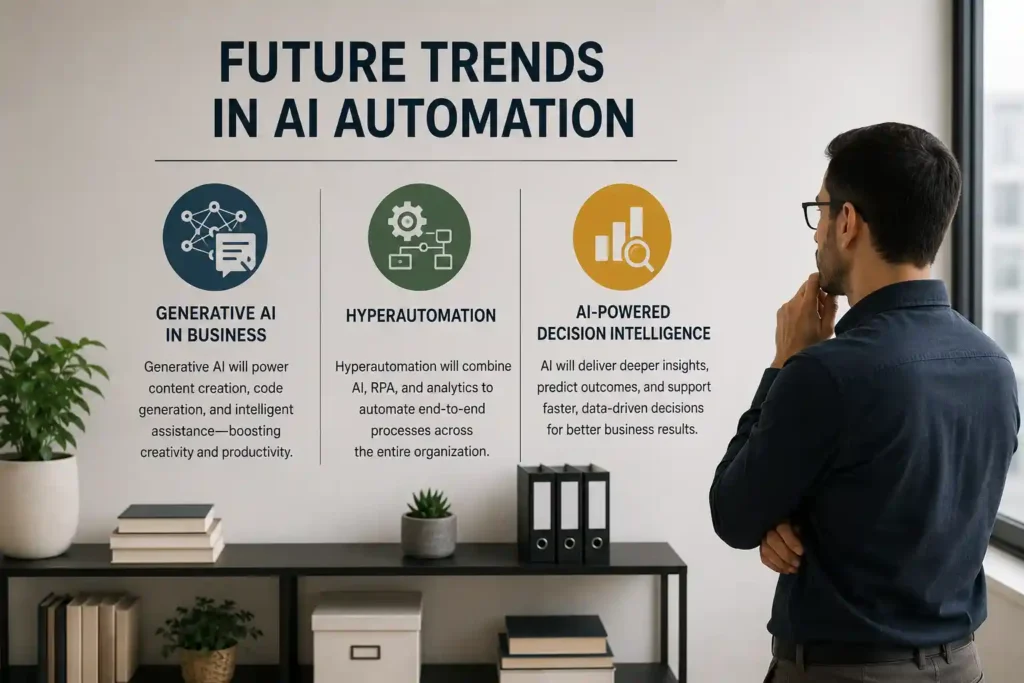
Generative AI in Business
Generative AI is transforming businesses by creating content, generating ideas, summarizing information, and assisting with customer interactions. Organizations use it to produce marketing materials, draft reports, develop software code, and enhance creative workflows. As generative AI becomes more advanced, businesses can improve productivity, reduce repetitive tasks, and deliver personalized experiences while allowing employees to focus on innovation, strategic planning, and higher-value responsibilities.
Hyperautomation
Hyperautomation combines artificial intelligence, robotic process automation, analytics, and other digital technologies to automate end-to-end business processes. Instead of improving individual tasks, it connects multiple systems to create seamless workflows across departments. Businesses adopting hyperautomation gain faster operations, fewer manual errors, improved scalability, and better resource utilization. This trend is expected to become a major competitive advantage for organizations seeking long-term operational excellence.
AI-Powered Decision Intelligence
Decision intelligence uses AI to analyze large datasets, identify trends, and recommend informed business actions. Executives rely on predictive insights for strategic planning, financial forecasting, and risk management. AI-powered recommendations support faster, data-driven decisions while reducing uncertainty. As technology evolves, decision intelligence will become an essential component of business leadership, helping organizations respond quickly to market changes and emerging opportunities.
How Businesses Can Prepare for an AI-Driven Future
Building an AI Strategy
Businesses should begin with a clear AI strategy aligned with organizational goals. Identifying business challenges, prioritizing automation opportunities, and defining measurable objectives create a strong foundation for successful implementation. Companies should also assess available data, technology infrastructure, and workforce capabilities before investing in AI solutions. A well-planned strategy minimizes risks while maximizing long-term value and sustainable business growth.
Creating a Culture of Innovation
Successful AI adoption requires a workplace culture that embraces innovation, collaboration, and continuous learning. Leaders should encourage employees to experiment with new technologies while supporting creativity and knowledge sharing. Training programs, cross-functional teamwork, and open communication help organizations adapt to technological change. An innovation-focused culture enables businesses to unlock the full potential of AI automation while remaining competitive in evolving markets.
Ensuring Responsible AI Governance
Responsible AI governance promotes transparency, fairness, accountability, and regulatory compliance. Businesses should establish ethical guidelines, monitor AI performance, and regularly evaluate potential risks. Protecting sensitive data and preventing algorithmic bias are essential for maintaining customer trust. Strong governance frameworks ensure AI systems operate responsibly while supporting sustainable growth and reinforcing confidence among employees, customers, and stakeholders.
Frequently Asked Questions (FAQs)
What is AI automation in the workplace?
AI automation in the workplace refers to using artificial intelligence to perform repetitive, data-driven, or decision-based tasks with minimal human intervention. It improves efficiency, reduces manual work, and supports employees in completing complex responsibilities more effectively.
Will AI automation replace human jobs?
AI automation may replace certain repetitive roles, but it also creates new opportunities requiring analytical thinking, creativity, and technical expertise. Most organizations will combine human skills with intelligent technologies instead of completely replacing employees.
Which industries benefit the most from AI automation?
Healthcare, manufacturing, finance, retail, logistics, education, and customer service benefit significantly from AI automation. These industries use intelligent technologies to improve productivity, enhance customer experiences, optimize operations, and reduce costs through smarter workflows and better decision-making.
What are the biggest challenges of AI automation?
Common challenges include implementation costs, data privacy concerns, cybersecurity risks, employee resistance, ethical considerations, and the need for workforce reskilling. Addressing these issues requires careful planning, responsible governance, and ongoing investment in technology and employee development.
How can businesses successfully implement AI automation?
Businesses should identify suitable processes, establish clear objectives, choose scalable AI solutions, train employees, measure performance, and continuously improve implementation strategies. Combining strong leadership with responsible AI practices increases long-term success and organizational resilience.
You might also like: How Generative AI Is Reshaping Content Creation Online
Conclusion
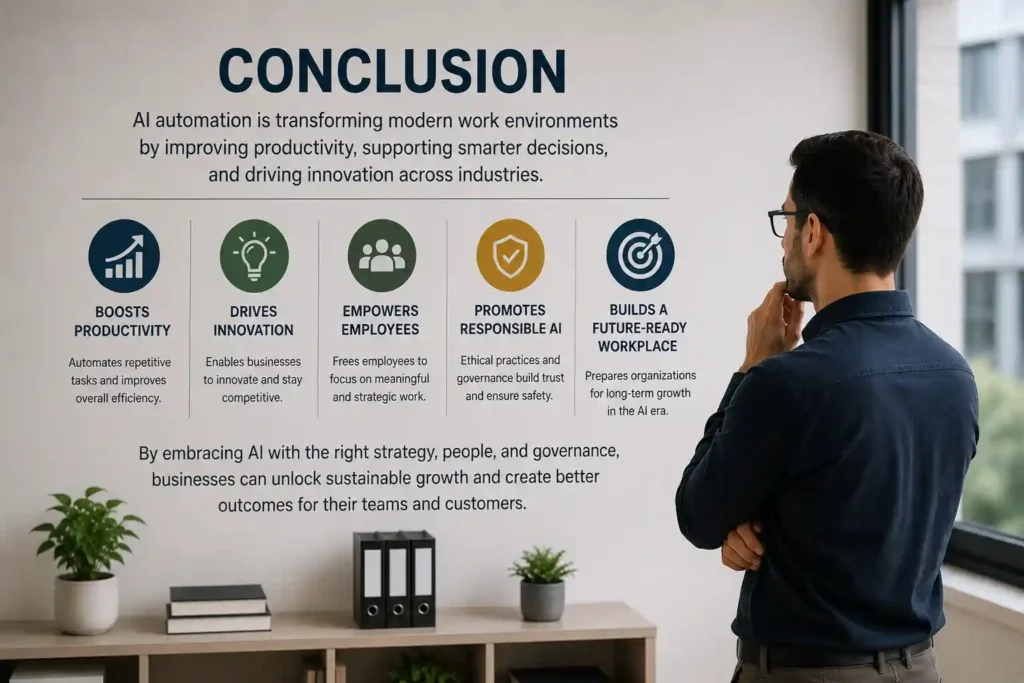
AI automation is reshaping modern work environments by improving productivity, supporting smarter decision-making, and enabling innovation across industries. Organizations that embrace emerging technologies while investing in employees, ethical governance, and continuous improvement will remain competitive in the digital economy. Although challenges such as workforce adaptation and data security require careful attention, the long-term benefits of AI automation outweigh the risks when implemented responsibly. By building effective strategies and encouraging collaboration between people and intelligent systems, businesses can unlock sustainable growth, deliver exceptional customer experiences, and confidently prepare for the future of work.