
How to Choose a Lightweight Stroller for Travel
Nobody thinks much about stroller weight in the shop. Then you’re standing at the bottom of a subway staircase with a toddler on one hip and a folded frame on the other hand, and it’s all you can think about. Strollers get hoisted into car trunks, collapsed in a hurry outside cafés, and handed over at airport gates. Over a year of daily use, a couple of extra pounds start to feel like a lot more.
That’s why lightweight strollers have become such a popular pick for families on the move. Below, I walk through what actually makes a stroller light, which features are worth keeping, how car seats and tricycles fit in, and what brands should know if they’re thinking about OEM manufacturing.
Why Weight Matters More Than You’d Expect
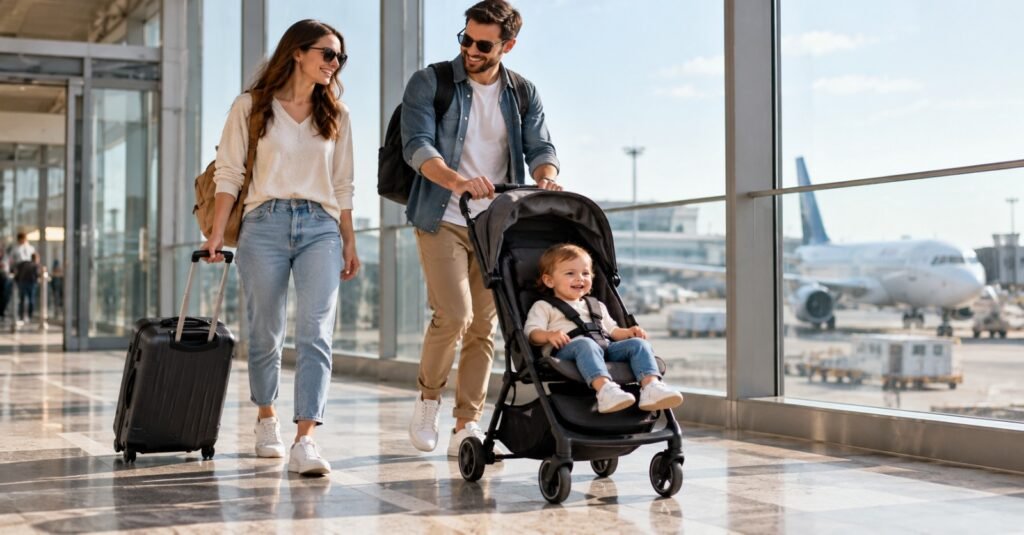
A heavy stroller tends to get left at home. If lifting it into the car feels like a chore, you’ll find reasons to skip the outing, or you’ll carry your child instead. A light one goes along without a second thought, which means more trips out for you and more fresh air for your little one.
It also matters if more than one person uses the stroller. Grandparents, nannies and partners don’t all have the same strength or patience for a clunky fold. If a stroller is going to be shared, the lightest practical model is usually the one that actually gets used.
What “Lightweight” Really Means
There’s no single number that defines it. A stroller can look great on the scale and still be awkward to fold, or collapse into a tidy package and then rattle apart on a rough pavement. Many parents find anything under about 7 kg (roughly 15 lb) easy to carry, but that depends on your height, your routes, and whether you mostly travel by car, train or plane.
If you’d like a starting point for comparing models, Bebelux, Best lightweight stroller shows how weight, fold size and canopy coverage are balanced in current designs, which helps you see the trade-offs before you buy. Whatever source you use, look past the headline weight. A better question is how the stroller feels with your child, a diaper bag and a few groceries on board.
Frame materials
Most lightweight strollers use aluminum frames, which strike a good balance between strength and weight. Steel is cheaper and tough, but it adds bulk. Magnesium and carbon fiber turn up at the premium end, and they raise the price more than they change your day-to-day experience. For most families, a well-built aluminum frame is plenty.
The fold
A light stroller only helps if it folds quickly. Try folding it with one hand, check that it locks on its own, and see whether it stands up by itself afterwards. That last feature is more useful than it sounds, since it keeps a muddy frame off the floor of a restaurant or train station. Also think about where it has to fit: your trunk, under a bus seat, or in an overhead cabin compartment if you fly often.
Wheels and suspension
Small wheels save weight and make folding easier, but they struggle on cobblestones, gravel and cracked sidewalks. Bigger wheels roll better and add size. Look for a middle ground, with wheels big enough for your usual surfaces and at least basic suspension so your child isn’t rattled around. Swivel front wheels with a lock option give you easy turning in shops and a steadier ride outdoors.
Features to Keep, and Features to Skip
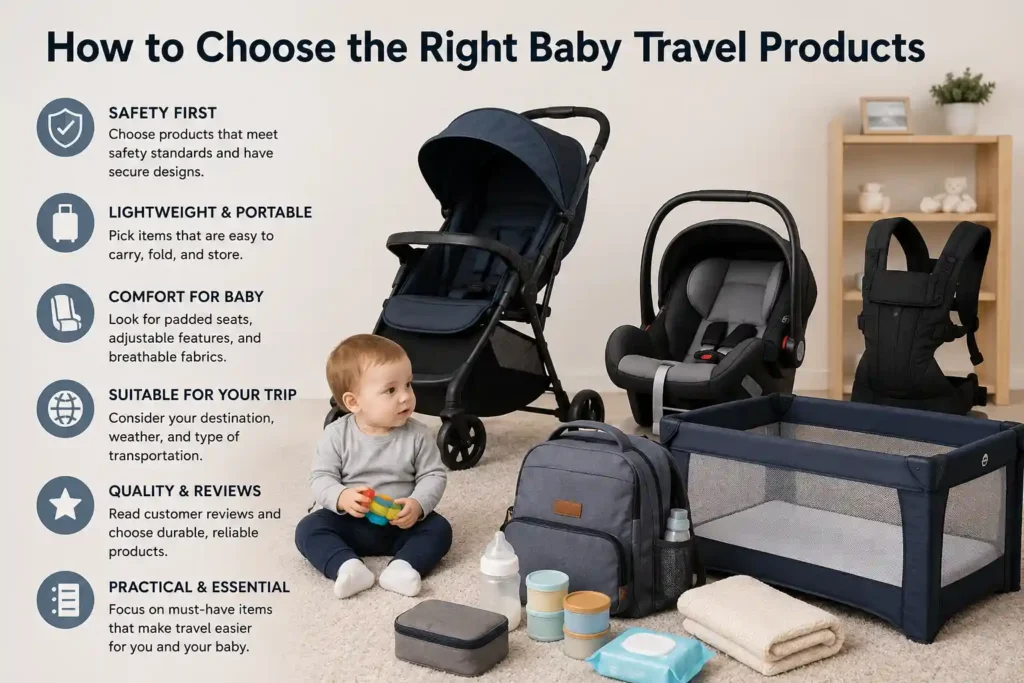
Cutting weight always involves trade-offs, so it helps to decide up front what you can’t do without. Most parents end up wanting a seat that reclines, ideally to a near-flat position for naps, along with a generous canopy, a secure five-point harness, brakes you can press with a shoe, and a basket large enough for the essentials.
What you can usually live without are the extras: oversized cup holders, decorative add-ons, fiddly adjustment systems you’ll never touch, and thick padding that makes the stroller harder to clean and carry. Fewer parts also means fewer things to break, so a simpler design is often a sign of good engineering rather than a lack of ambition.
Safety Standards
Saving weight should never come at the cost of safety. Reputable strollers are tested against recognized standards. In Europe, EN 1888 is the common reference for strollers, and in the United States it’s ASTM F833. Both cover things like stability, braking, harness strength and the risk of trapped fingers in the folding mechanism.
When you’re comparing products, check whether the manufacturer can supply test reports for the markets you care about. A label alone isn’t enough. Look for clear instructions and warnings, and make sure the weight limit suits your child’s size. A stroller that’s slightly heavier but properly tested is a better choice than an ultralight model with vague credentials.
Pairing a Stroller with a Car Seat
For many families, the stroller and car seat work as a pair. A compatible setup lets you move a sleeping newborn from the car to the stroller without waking them. You can get there in two ways. A travel system has a frame that accepts an infant car seat directly, usually with adapters. Or you can use a lightweight stroller alongside a separate car seat and move the child between them.
If you go the travel-system route, confirm that your specific car seat is listed as compatible and that the adapters come with it or can be bought separately. Car seats also have to meet regional regulations, such as UN ECE R129 (i-Size) in Europe or FMVSS 213 in the United States. Follow the installation instructions closely, and check that the seat fits your vehicle properly before you rely on it.
One practical point: an infant seat on top of a stroller frame can add up, especially once your baby has grown. If you’ll be carrying the seat a lot, weigh the whole combination rather than each piece on its own.
Where Tricycles Come In
As children grow, the stroller slowly takes a back seat. Many toddlers want to move under their own steam, and a baby tricycle is a popular bridge between being pushed and walking confidently. The better convertible models have a parent push handle, a safety harness or guard ring, and removable parts so the trike can change as the child does.
For travel, it’s worth looking for one that folds or comes apart easily. Some families keep a light stroller for long days out and a trike for park visits and short trips around the neighborhood. Buying both from the same brand can simplify replacements and spare parts, though each product should still be judged on its own merits.
A Note for Brands Considering OEM Manufacturing
Not everyone reading about strollers is a parent. Retailers, start-up brands and distributors often look for a manufacturing partner to develop their own baby travel products. With OEM manufacturing, a brand sells products built to its own specifications. ODM, by contrast, lets a brand adapt a design the factory already has.
A sensible OEM project usually moves through a few stages. You start by defining what you want: target weight, folded size, materials, price range and the markets you plan to sell in. Next comes sampling, where you handle prototypes yourself and check the fold and the build quality. Compliance testing follows, since the product has to meet the standards of each destination market, and you should keep the reports on file. After that you agree on minimum order quantities, lead times, packaging and branding, and you arrange inspections during production rather than only at the end.
Good communication matters as much as good engineering. Ask potential partners about their experience with this exact product category, request photos or video of their production lines, and be clear from the start about who pays for tooling and who owns the design. A small trial order is a low-risk way to test the relationship before committing to larger volumes.
It also pays to think beyond the stroller itself. Packaging that survives shipping, manuals in the right languages, and easy access to spare parts all shape how customers feel about a product, and they cut down on returns.
A Quick Checklist Before You Buy
Run through these questions before you decide:
- Can you lift it comfortably with one hand, with a bag on your shoulder?
- Is the fold quick, intuitive and compact enough for your car or trips?
- Does the seat recline smoothly, and does the canopy give real coverage?
- Will the wheels cope with your usual routes?
- Does the seller list recognized standards and provide documentation?
- If you need a car seat, is your model officially supported?
- Can you get replacement parts like wheels and canopies later?
If you can, try the stroller in person, or buy from a seller with a fair return policy. Fold it, unfold it, and push it around for a few minutes. That short test will tell you things a spec sheet never will.
Common Questions
What is the best lightweight stroller according to reviews?
There’s no single winner, but a few models keep coming up. The Bump tested 25 travel and lightweight strollers and chose the Joolz Aer² with Cot as the overall best travel stroller for 2026, praising its fast, ultra-compact fold and the carrycot that folds with it. Mumsnet’s parent testers named the Stokke YOYO³ best overall lightweight stroller. Zola’s vetted list puts the Nuna TRVL first, with the UPPAbaby Minu V3 for daily use and the Bugaboo Butterfly 2 for premium travel.
If I had to pick one for most families, it would be the Joolz Aer² or the Stokke YOYO³. Both are well reviewed and fold small.
What stroller did Kim Kardashian buy?
The best-documented one is a Silver Cross Balmoral pram. People reported that Kris Jenner bought multiple Silver Cross strollers for her granddaughters, including a $2,700 black Balmoral pram for Kim and Kanye West’s daughter, Chicago. So it was a gift from her mother rather than Kim’s own purchase.
A retailer blog also links her to Orbit Baby and Mima Xari, but I couldn’t confirm that from a stronger source, so treat it as unverified. Her sisters’ picks are better documented: Khloé used a Nuna MIXX, and Kylie Jenner used a Fendi stroller.
What is a good lightweight stroller for a baby?
For a young baby, the lightest option isn’t automatically the best. Newborns need to lie flat or nearly flat, so look for a lie-flat seat or a carrycot or infant car seat that attaches to the frame. Two options reviewers single out:
- Joolz Aer² with Cot: The Bump highlighted its built-in carriage mode and sturdy carrycot, which give it newborn-to-toddler range.
- Silver Cross Clic 2: Mumsnet lists it as the best lightweight stroller with a lie-flat seat.
On weight, one guide treats under 17 lbs, a one-hand fold and overhead-bin fit as the markers of a good travel stroller. That’s a reasonable target for most families.
What is the number one rated stroller?
It depends on who is rating. Consumer Reports tested over 100 strollers, and its top pick for 2026 is the Baby Jogger City Mini GT3, the highest-rated widely available model in its lab tests. It’s also on the heavy and bulky side. Retail and affiliate reviewers more often crown the UPPAbaby Vista V3, and one test lists it as best overall at about $1,000, with a smooth ride, single-to-double conversion and strong resale value. Treat that one with some caution, since it’s a commercial site.
What are the top 5 strollers for 2026?
This is my own shortlist, pulled from the sources above rather than an official ranking:
- Baby Jogger City Mini GT3: Consumer Reports’ top pick, best for lab-tested all-round performance.
- UPPAbaby Vista V3: Best for families who want a stroller that grows from one child to two.
- Joolz Aer²: Best travel stroller per The Bump.
- Stokke YOYO³: Best overall lightweight per Mumsnet.
- Nuna TRVL: Best overall travel stroller on Zola’s list, with a self-folding frame.
What is the Rolls-Royce of strollers?
Two names claim the title. Silver Cross is the older claim: it has been called the “Rolls-Royce of strollers” since the 1950s, and royal families have used it. Its Balmoral pram is the classic example, though one owner called it massive after loading an 80-pound carriage into her car.
Bugaboo is the more modern answer. NPR described it as considered the Rolls Royce of strollers, with a price near 1,000.Forpureshowpieceluxury,designercollaborationsgomuchhigher,suchasDior’sInglesina-madestrollerataroundUS4,800.
If you tell me your budget and whether you mainly travel by car, plane or public transport, I can narrow this to one or two picks.
Wrapping Up
The best lightweight stroller isn’t just the one with the smallest number on the spec sheet. It’s the one that suits your routine: easy to lift, quick to fold, comfortable for your child, and backed by credible safety testing. Once you factor in car seats and tricycles, you can put together a travel setup that grows with your family without adding stress.
The same thinking applies to brands. Clear specifications, tested designs and an open manufacturing process lead to products parents can trust. Whether you’re shopping for your own child or planning a product line, focus on real-world usability, verified safety and honest information, and the right choice gets a lot easier.
Where the answer depends on the source, I’ve said so. Several “best stroller” lists online are affiliate sites with unclear testing, so I leaned on The Bump, Mumsnet, Consumer Reports and Zola.