
The Rise of Quantum Computing: What It Means for the Future of Technology
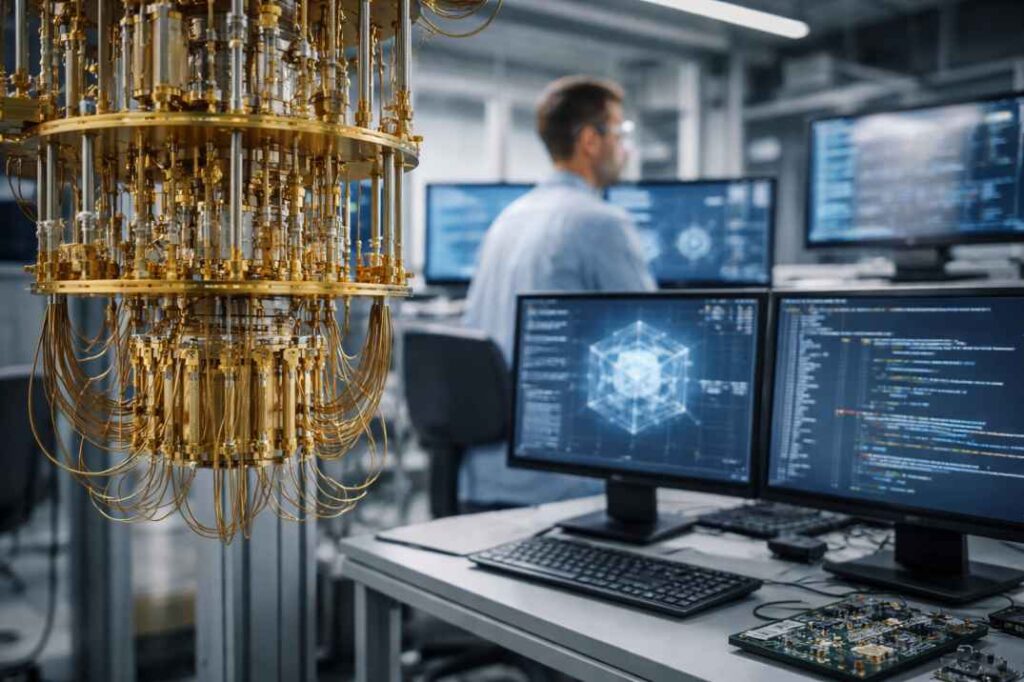
Quantum computing is an advanced form of computation that leverages the principles of quantum mechanics to process information. Unlike traditional computers, which rely on binary bits represented as 0 or 1, quantum computers use qubits, which can exist in multiple states simultaneously. This unique property allows quantum systems to handle vast amounts of data and perform complex calculations at unprecedented speeds. Industries ranging from finance to healthcare are beginning to explore quantum computing for its potential to revolutionize problem-solving.
How It Differs from Classical Computing
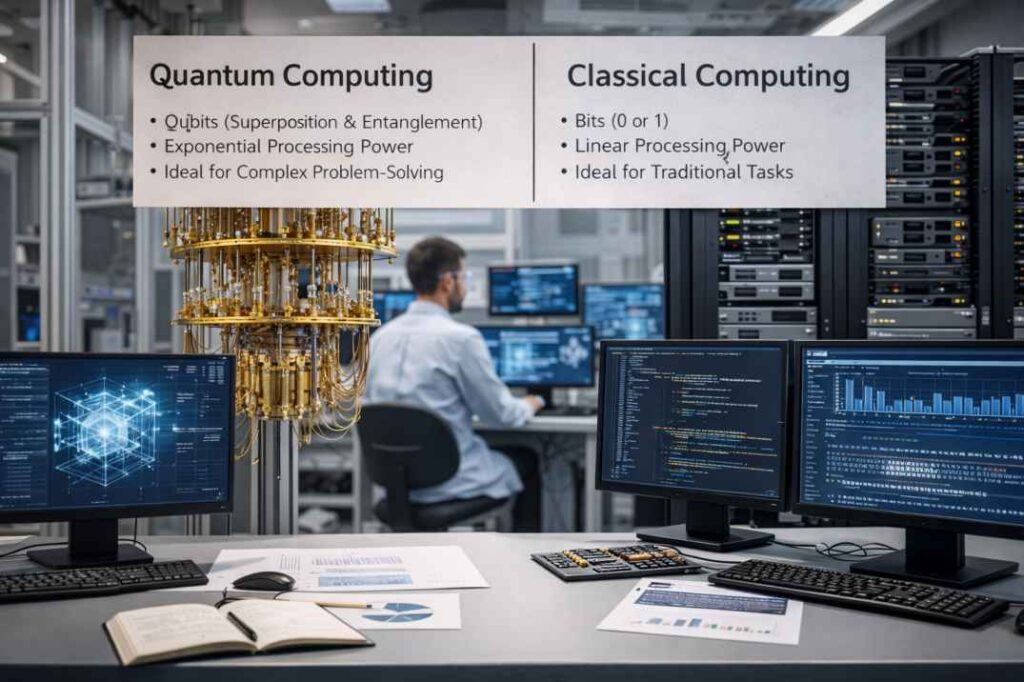
Classical computing relies on deterministic binary logic, meaning every calculation follows a linear path based on either a 0 or a 1. Quantum computing, on the other hand, uses superposition and entanglement, enabling qubits to represent multiple possibilities simultaneously. This allows quantum machines to solve problems that would take classical computers millions of years in just a fraction of the time. While classical computers excel at everyday tasks, quantum systems are poised to tackle highly complex challenges such as cryptography, optimization problems, and molecular simulations.
Why It Matters Now
The rise of quantum computing comes at a critical technological juncture. As classical computing approaches its physical limitations, especially in processing power and energy efficiency, quantum systems provide a path forward for next-generation computation. Governments, corporations, and research institutions are investing heavily in quantum technology, recognizing its potential to redefine innovation across sectors and provide strategic advantages in national security, scientific research, and artificial intelligence.
The Science Behind Quantum Computing
Understanding Qubits and Superposition
At the core of quantum computing lies the qubit, a unit of quantum information. Unlike classical bits, qubits can exist in superposition, representing both 0 and 1 simultaneously. This capability allows quantum computers to explore multiple solutions to a problem at the same time, dramatically increasing computational efficiency. Superposition, combined with quantum parallelism, is what gives quantum machines their unmatched processing power for complex calculations.
Quantum Entanglement and Its Significance
Another critical concept is quantum entanglement, a phenomenon where two or more qubits become intrinsically linked. Changes to one qubit instantly affect its entangled partner, regardless of distance. This property allows for ultra-fast communication and coordinated processing across qubits, making entanglement essential for building scalable quantum systems and executing advanced algorithms that classical computers cannot replicate.
Quantum Gates and Algorithms
They manipulate qubits by changing their states and enabling interactions required for computation. Coupled with quantum algorithms like Shor’s algorithm for factoring large numbers or Grover’s search algorithm, quantum gates allow for efficient problem-solving in areas such as cryptography, optimization, and AI applications. These algorithms illustrate the potential of quantum computing to outperform classical systems in specific domains.
You might also like this: What is serlig
History and Evolution of Quantum Computing
Early Theoretical Foundations
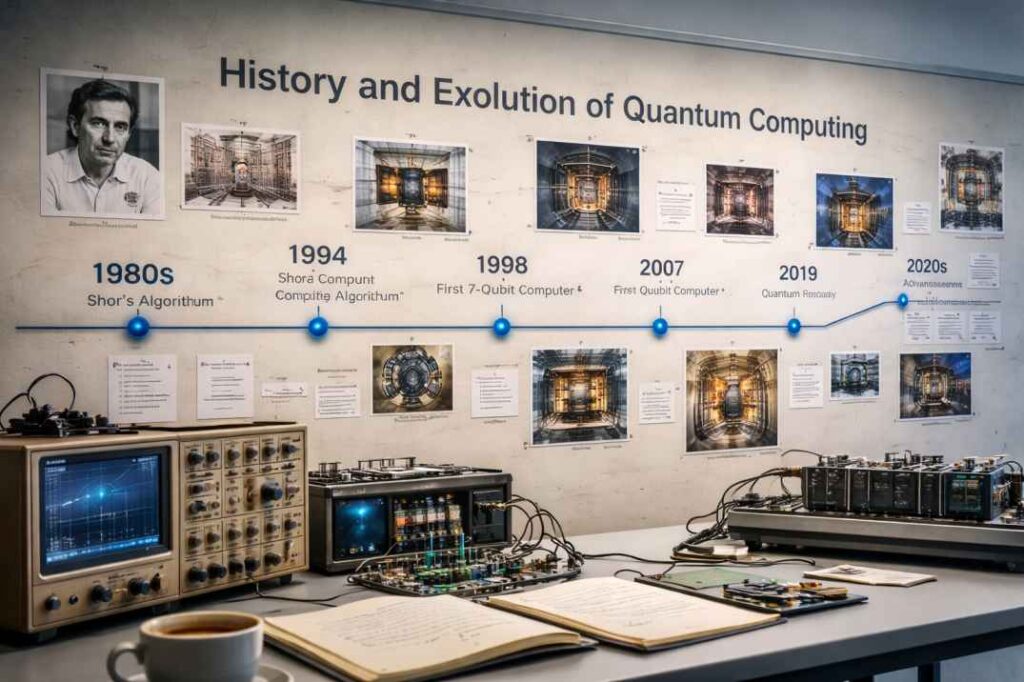
Quantum computing has its roots in the 1980s, when physicists like Richard Feynman and David Deutsch proposed the concept of machines that could simulate quantum phenomena. These early ideas challenged conventional computing paradigms, highlighting the limitations of classical systems in modeling quantum processes. The theoretical groundwork laid during this period remains foundational to modern quantum research.
Milestones in Quantum Research
Significant milestones include the creation of the first qubits using trapped ions, superconducting circuits, and photonic systems. Researchers demonstrated early quantum algorithms and achieved quantum supremacy, where a quantum computer performs a calculation infeasible for classical machines. These breakthroughs have progressively validated the practical potential of quantum technology and accelerated investment and interest in the field.
Modern Quantum Hardware Developments
Today, quantum hardware has evolved from laboratory prototypes to commercial devices capable of running real-world experiments. Companies like IBM, Google, and Microsoft have unveiled cloud-based quantum computing platforms, allowing broader access for experimentation and research. Simultaneously, startups are developing specialized hardware and error-correction technologies, contributing to the rapid evolution of scalable quantum systems.
Key Players in Quantum Technology
Major Tech Companies Leading the Charge
Global technology leaders are at the forefront of quantum innovation. Companies like IBM and Google have developed powerful superconducting qubit systems, while Microsoft focuses on scalable quantum software platforms. These corporations invest billions in research, aiming to achieve practical quantum advantage across multiple industries.
Prominent Startups and Research Labs
Numerous startups, including Rigetti Computing and IonQ, are pioneering new approaches to qubit design and error correction. Academic and national research labs also play a vital role, conducting cutting-edge experiments that push the boundaries of quantum theory into practical application.
Global Investments and Collaborations
Quantum computing is a highly collaborative field. Governments worldwide, from the United States to China and the European Union, have launched multi-billion-dollar initiatives to accelerate quantum research. Partnerships between public institutions and private companies are crucial for funding infrastructure, developing talent, and achieving breakthroughs that could reshape computing in the coming decades.
Real-World Applications Today
Finance and Risk Modeling
Quantum computing is already reshaping the financial sector. Traditional computers struggle with complex risk modeling, portfolio optimization, and high-frequency trading simulations due to the sheer volume of variables. Quantum computers, with their ability to process vast datasets simultaneously, allow financial institutions to identify patterns, assess risk more accurately, and make faster decisions. This capability enhances market predictions and can provide a competitive edge in increasingly data-driven markets.
Drug Discovery and Healthcare Innovations
Healthcare and pharmaceuticals are among the most promising areas for quantum technology. Quantum computers can simulate molecular interactions at a level of precision unattainable by classical machines, speeding up drug discovery and reducing development costs. This capability is particularly valuable in tackling complex diseases like cancer and neurodegenerative disorders. Additionally, quantum computing aids in personalized medicine, enabling healthcare providers to tailor treatments to individual genetic profiles.
Artificial Intelligence and Machine Learning
Quantum computing complements artificial intelligence (AI) by accelerating machine learning algorithms and improving pattern recognition. Quantum-enhanced AI can analyze massive datasets faster, uncover hidden correlations, and optimize neural networks efficiently. This has applications in predictive analytics, natural language processing, and autonomous systems, positioning quantum computing as a key enabler of next-generation AI capabilities.
You might also like this: Kerkt Explained
Potential Future Applications

Advanced Cryptography and Cybersecurity
One of the most transformative applications of quantum computing is in cryptography. Quantum algorithms, such as Shor’s algorithm, can break traditional encryption methods, posing both challenges and opportunities. Governments and organizations are exploring quantum-resistant cryptography to secure sensitive data. In the future, quantum networks could provide ultra-secure communication channels, safeguarding financial transactions, government communications, and personal data.
Climate Modeling and Energy Optimization
Quantum computing has the potential to revolutionize environmental research. Simulating climate patterns with high accuracy requires enormous computational power, which classical systems often cannot deliver. Quantum systems can model complex interactions in climate systems, predict extreme weather events, and optimize renewable energy distribution. This could lead to more effective environmental policies and improved resource management, mitigating the effects of climate change.
Next-Generation Materials and Manufacturing
Material science stands to benefit significantly from quantum technologies. Quantum computers can simulate the properties of new materials, accelerating the design of stronger, lighter, and more sustainable substances. This advancement can transform industries such as aerospace, automotive, and electronics. Quantum-enhanced manufacturing processes may also improve efficiency and reduce waste, making production more cost-effective and environmentally friendly.
Challenges Facing Quantum Computing
Technical Barriers and Error Rates
Qubits are extremely sensitive to environmental noise, leading to high error rates in calculations. Maintaining stable quantum states requires sophisticated error correction methods, and even minor disturbances can compromise results. Addressing these challenges is essential for achieving reliable, large-scale quantum computation.
Hardware Limitations and Scalability
Building scalable quantum hardware remains a major obstacle. Current devices can only manage a limited number of qubits, constraining the complexity of solvable problems. Engineers face challenges in manufacturing, cooling, and maintaining qubit coherence, which slows down practical deployment. Expanding the number of qubits while ensuring stability is critical for realizing the full potential of quantum systems.
High Costs and Resource Demands
Quantum computing requires substantial investment in research, infrastructure, and maintenance. Superconducting qubits, cryogenic systems, and specialized facilities drive up costs, making access difficult for smaller organizations. Additionally, training talent to develop and operate quantum systems remains a challenge, creating barriers for widespread adoption across industries.
Ethical and Societal Implications
Security Risks and Data Privacy
Quantum computing introduces new security and privacy challenges. Its ability to break current encryption standards could expose sensitive information, requiring immediate development of quantum-safe security protocols. Organizations and governments must prepare for a future where quantum capabilities might compromise existing data protection frameworks.
Impact on Employment and AI Systems
The adoption of quantum technology may disrupt traditional job roles, particularly in sectors like finance, logistics, and AI development. While it creates opportunities for quantum engineers and data scientists, routine positions may be automated or replaced. Ensuring equitable access to education and training will be essential to minimize societal disruption.
Responsible Quantum Development
Ethical deployment of quantum computing is critical. Developers and policymakers must balance technological advancement with societal responsibility, establishing guidelines for transparency, security, and environmental impact. International collaboration on quantum ethics can help ensure that the technology benefits humanity without creating new inequities or risks.
You might also like this: Laaster Review 2026
Quantum Computing vs Classical Computing
Speed, Efficiency, and Problem-Solving
Quantum computing offers unmatched speed and efficiency for certain complex problems that classical computers struggle to handle. While classical systems process one calculation at a time using binary bits, quantum computers leverage qubits in superposition, exploring multiple solutions simultaneously. This enables rapid problem-solving in areas like large-scale optimization, cryptography, and molecular simulation, where classical systems may take years to compute. However, for routine tasks, classical computers remain faster, more reliable, and energy-efficient.
Complementary vs Replacement Technologies
Quantum computers are not expected to replace classical computers entirely. Instead, they function as complementary technologies, tackling specialized problems while classical systems handle everyday computing needs. Businesses and researchers increasingly view quantum systems as tools to enhance existing infrastructures, such as combining classical simulations with quantum algorithms for more accurate results. This hybrid approach ensures organizations benefit from the strengths of both technologies.
Industries Most Likely to Transition First
Industries dealing with complex computations are poised to adopt quantum computing first. Finance, pharmaceuticals, aerospace, and energy sectors will likely see early integration, as quantum systems optimize risk analysis, drug discovery, material design, and energy distribution. Companies with high computational demands and access to specialized talent will gain a competitive advantage, while other sectors may adopt quantum solutions gradually as the technology matures.
Government Policies and Global Competition
National Quantum Initiatives
Governments worldwide recognize quantum computing as a strategic priority. The United States, China, and the European Union have launched ambitious initiatives to fund research, build infrastructure, and develop talent. National quantum programs aim to accelerate commercialization, support startups, and maintain technological leadership, reflecting the importance of quantum computing for economic growth, cybersecurity, and scientific advancement.
International Collaboration vs Competition
Quantum computing fosters both collaboration and competition globally. Research partnerships allow knowledge sharing between universities, corporations, and national labs, enabling rapid innovation. At the same time, countries are competing to achieve quantum supremacy, the milestone where a quantum system outperforms classical machines on practical tasks. Balancing cooperation with competitive strategy is essential to ensure technological progress while maintaining global security and ethical standards.
Regulation and Standardization Challenges
As quantum technology evolves, regulatory frameworks and industry standards are struggling to keep pace. Governments face challenges in defining safe practices for data security, intellectual property, and ethical deployment. Standardizing protocols for quantum hardware, software, and communication networks is critical to facilitate interoperability, reduce risks, and encourage widespread adoption without stifling innovation.
Future Outlook: What’s Next?
Emerging Trends in Quantum Hardware
Quantum hardware is advancing rapidly, with innovations in superconducting qubits, trapped ions, and photonic systems. Researchers are developing more stable qubits, scalable architectures, and improved error correction techniques. These trends indicate that future quantum computers will be more powerful, reliable, and accessible, enabling complex computations that were previously impossible.
Breakthrough Algorithms on the Horizon
New quantum algorithms are emerging that could revolutionize problem-solving. For example, algorithms for optimization, machine learning, and chemical simulations are showing practical promise. Breakthroughs in quantum software will allow computers to perform tasks with higher efficiency, creating new opportunities for industries, research, and AI development.
Predictions for the Next Decade
Over the next ten years, experts predict that quantum computing will transition from experimental research to commercial application. Widespread adoption is expected in sectors like finance, healthcare, and logistics, while hybrid quantum-classical systems will become standard in research institutions. As hardware, software, and security measures mature, quantum computing may reshape how complex problems are approached globally, unlocking innovation on a previously unimaginable scale.
You might also like this: Complete Guide to Google AdSense Approval
FAQs: Quantum Computing
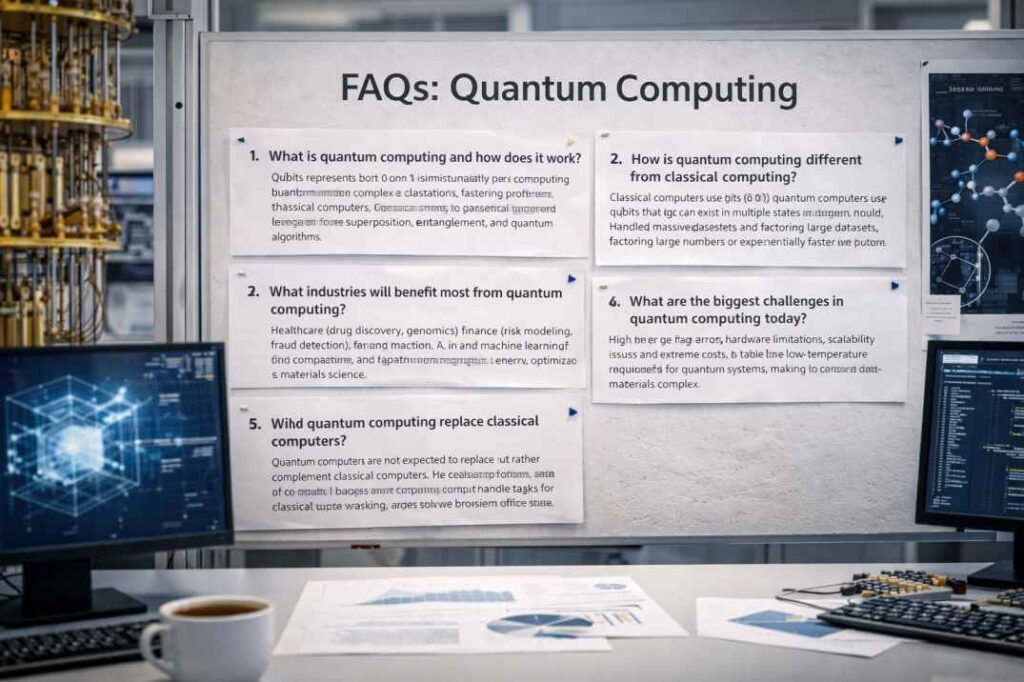
How is quantum computing different from classical computing?
This allows them to handle massive datasets, optimize complex systems, and solve problems like factoring large numbers exponentially faster than traditional computers.
What industries will benefit most from quantum computing?
Quantum computing has transformative potential in healthcare (drug discovery, genomics), finance (risk modeling, fraud detection), AI and machine learning, cryptography, energy optimization, and materials science. Any sector requiring advanced computation can benefit.
What are the biggest challenges in quantum computing today?
Current challenges include high error rates, hardware limitations, scalability issues, and extreme costs. Additionally, quantum systems require stable low-temperature environments, making large-scale deployment complex.
Will quantum computing replace classical computers?
Quantum computers are not expected to replace classical computers but rather complement them. They excel at specific complex problems, while classical computers remain efficient for everyday tasks like web browsing, office software, and standard databases.
Conclusion
Quantum computing represents a paradigm shift in computation, offering unprecedented speed, problem-solving capabilities, and industry applications. While classical systems remain essential for everyday tasks, quantum technology complements and enhances them, providing solutions for challenges beyond conventional limits. Governments and companies are investing heavily to gain an advantage, highlighting its strategic significance. With emerging hardware, breakthrough algorithms, and increasing global collaboration, the future of quantum computing promises to transform industries, scientific research, and technological innovation over the coming decade, marking a new era in computational power.